
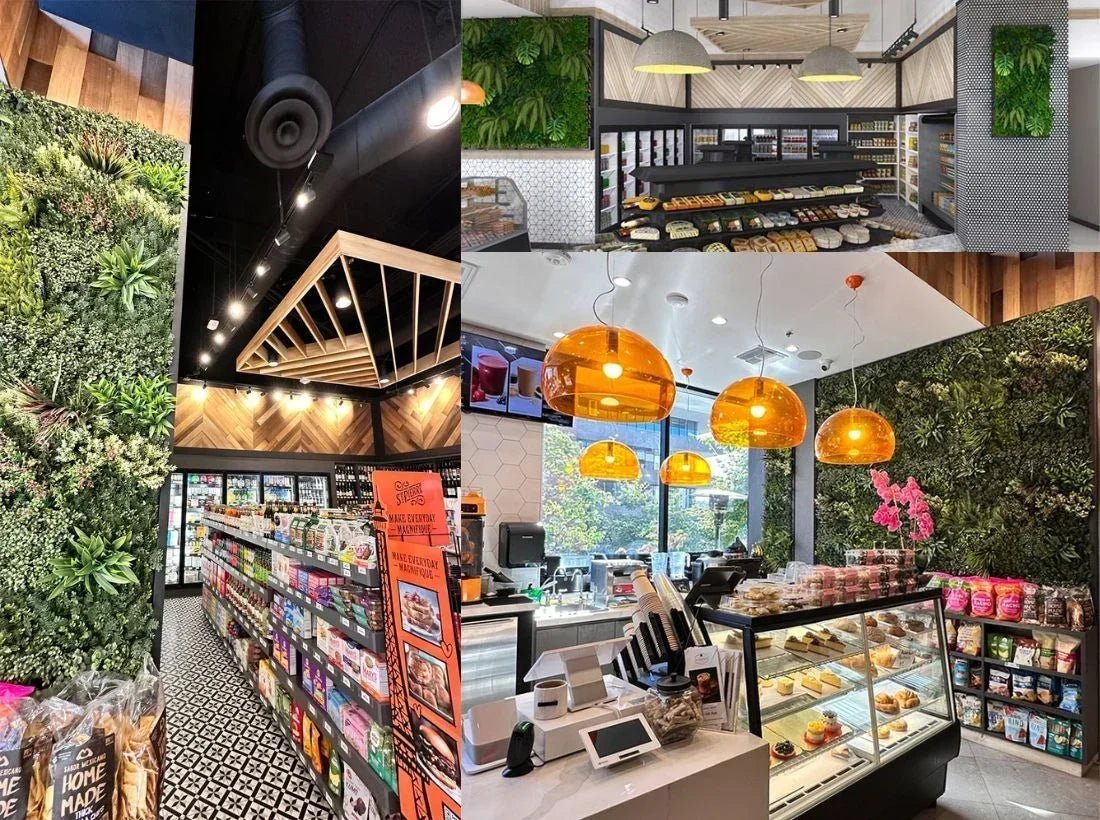
When a studio like Mindful Design Consulting, a San Diego commercial practice specializing in franchise and multi-location brand expansion, specifies a product for a commercial fit-out, it isn't a casual decision but also a stamp of approval.
So, when they specified Designer Plants artificial green wall panels for the Camino Farms Market, it was a clear view into how artificial greenery functions at the highest level of commercial design.

Here’s a look at the entire project, why the studio specified these panels, and what the design rationale means for commercial operators and interior designers evaluating artificial green walls for their next site.
What Did Mindful Design Consulting Need and Why?
Mindful Design Consulting selected two products from the Designer Plants commercial range for their retail installations: the Lush Fern Green Wall Panel and the Amazon Jungle Vertical Garden Panel.

The choice of two distinct panel styles is itself a design decision worth noting. The Lush Fern brings fine-textured, layered foliage with a softer, more naturalistic character, which is well suited to transition zones, seating separators, and surfaces where the greenery is meant to feel woven into the space rather than declared.

The Amazon Jungle panel is the opposite in energy: dense, tropical, visually commanding, and layered with multiple species of foliage that reads as botanical at close range. Together, they give a retail interior two different registers of greenery: quiet and lush.
As Mindful Design Consulting noted:
“The layered foliage, natural depth, and mix of textures help these green walls feel much closer to living plants than flat images or two-dimensional wall art."
For a studio working on franchise and multi-location expansion, this variety is functional. Different locations, different footprints, and different brand expressions still need to look cohesive, so the same product range needs to flex across all of them.
How Did Green Walls Work in the Camino Farms Market?
Mindful Design Consulting demonstrated how artificial greenery can serve as a primary, multi-functional design element across a hybrid retail and dining space.

Instead of treating green walls as a single, monolithic feature, the studio integrated the panels across several distinct roles throughout the interior:
-
Product display backdrops: Placed behind retail shelving, the green panels create a rich contrast against the display fixtures. The greenery recedes visually to let the merchandise take center stage and adds the kind of depth that paint can't achieve.
-
Architectural zone separators: The panels define distinct functional areas without building solid walls or blocking line-of-sight. By using greenery as a divider, the design connects the dining and retail zones while keeping the floor plan open.
-
Framed architectural features: In key areas, the panels are set within custom architectural surrounds, acting as custom biophilic wall art. This creates high-impact, photographable focal points that kick up the interior without structural installations.
-
Material contrast and layering: The lush foliage is paired directly with natural timber, tile, and structural elements. Warm wood tones set against deep greens soften the surfaces of the environment and deliver a modern and timeless atmosphere.
Camino Farms Market serves as a practical blueprint for biophilic design and shows just how one single specification can solve complex spatial challenges.
The designers at Mindful Design even said that since “there’s no need to worry about sunlight, watering, or growing conditions, this opens up a whole new level of design freedom, and placement can be decided based on function and aesthetics alone."
Why Are Design Studios Using Artificial Over Living Green Walls?
The short answer is operationality. But there’s still a good deal of nuance we need to consider.

Mindful Design Consulting put it well:
The problem is that incorporating living plants into a business is not always practical. Floor space may be limited, the design may call for a cleaner aesthetic, or the care required to keep plants healthy simply may not fit the daily demands of a commercial environment.

For commercial operators, this is the problem that artificial greenery solves structurally. The specific advantages that make artificial panels the designer-preferred specification in commercial contexts are:
-
No maintenance obligation for the operator. A living green wall requires irrigation systems, specialist horticultural maintenance, lighting calibration, and regular plant replacement. An artificial panel wall requires an occasional wipe-down once or twice a month and won’t wilt because of any environmental factors.
-
Placement freedom. Artificial green walls don’t need sunlight, water, or specific growing conditions, so panels can go where the design calls for them, without depending on the building’s conditions.
-
Consistent appearance across multiple sites. For a franchise or multi-location brand, visual consistency is an imperative. A well-chosen product from a single supplier, installed across multiple locations, delivers exactly that. Plus, our commercial range is engineered to deliver batch-consistent color and density.
-
Documented material performance. Our panels are engineered from LDPE with integrated RealTex foliage technology, ISO-certified UVTex UV inhibitors within the leaf, and NFPA 701 fire-resistance certification (for select products). These are the material specifications that you may need on record for a project sign-off, and they're available from on request, before any order is placed
What Can Green Walls Do for a Commercial Interior?
Beyond basic aesthetics, artificial green walls function as a high-impact design tool that solves common spatial and marketing challenges in commercial fit-outs like:
-
Driving passive social media marketing with visual elements that draw customer attention. Incorporating green walls into touchpoints (entrances, feature walls, etc.) creates backdrops that encourage visitors to take photos and post them online.
-
Maximize revenue-generating floor space with wall-mounted greenery that activates underutilized vertical space but still packs a punch.
-
Reinforce brand storytelling with the help of greenery, which acts as a physical extension of a brand’s identity. Choosing the right foliage texture, lighting, and surrounding materials translates a brand’s aesthetic into a tangible experience.
-
Softening hard commercial surfaces by using foliage to introduce texture, depth, and warmth, softening the architecture and creating a more welcoming environment for guests.
For more on how commercial studios and fit-out operators have applied this across different industry categories, read our gudies:


What’s the Process for Design Studios on Commercial Projects?
For designers specifying Designer Plants products for client projects, we provide a dedicated commercial specification service that operates differently from a consumer purchase:
-
Samples of any panel in the commercial range, delivered to the studio for client approval before any quantity is committed
-
Fire-resistance documentation (NFPA 701) and UV certification (ISO, UVTex) for panels specified in public-facing commercial environments
-
Coverage planning, including panel counts, guidance, and installation documentation for the specific project
-
Trade and volume pricing for qualifying studios and operators

If you're a design studio, interior architect, or fit-out contractor working on a commercial project where artificial green walls are under consideration, the right first step is a free consultation with our expert team.
Finishing Thoughts
Commercial interior design relies on products that balance high visual impact with long-term operational reality.

If you use artificial green walls strategically, the panels can serve as active commercial tools that guide customer flow, elevate product displays, create shareable social media backdrops, and reinforce brand identity.
For interior designers, architects, and operators planning a commercial fit-out, incorporating artificial greenery early in the space-planning phase opens up significant creative freedom.
To help move your concept from brief to execution, our team provides physical sample packs, technical spec sheets, and fire-rating documentation to support your specification process.
So don’t wait up and get in touch with our team. We can’t wait to hear from you.
FAQs
-
Why do design studios choose artificial green walls instead of living ones?
-
The primary reasons are operational: artificial panels require no irrigation, no horticultural maintenance, no light calibration, and no plant replacement. For commercial operators managing multiple locations or high-traffic retail environments, this represents a reduction in ongoing cost and management complexity. Design freedom is equally important because the panels go where the design calls for them, not where building conditions permit.
-
Can Designer Plants supply across multiple locations for a franchise or multi-site project?
-
Yes. We supply commercial operators and design studios with volume orders, batch-consistent product, and trade pricing for qualifying projects. Contact our commercial team at sales@designerplants.com to discuss multi-site specification.
-
Do commercial green walls need fire certification for retail and hospitality environments?
-
In most US commercial public-facing environments, fire-rated materials are required by building code. Specific panels from Designer Plants are NFPA 701-compliant and available across the commercial panel catalogue, with lab documentation available to buyers on request.
-
How do I get samples and specification documentation for a commercial project?
-
Contact our commercial team with your project brief. We provide samples, fire-resistance reports, UV certification documentation, coverage calculations, and trade pricing ahead of any order commitment.