
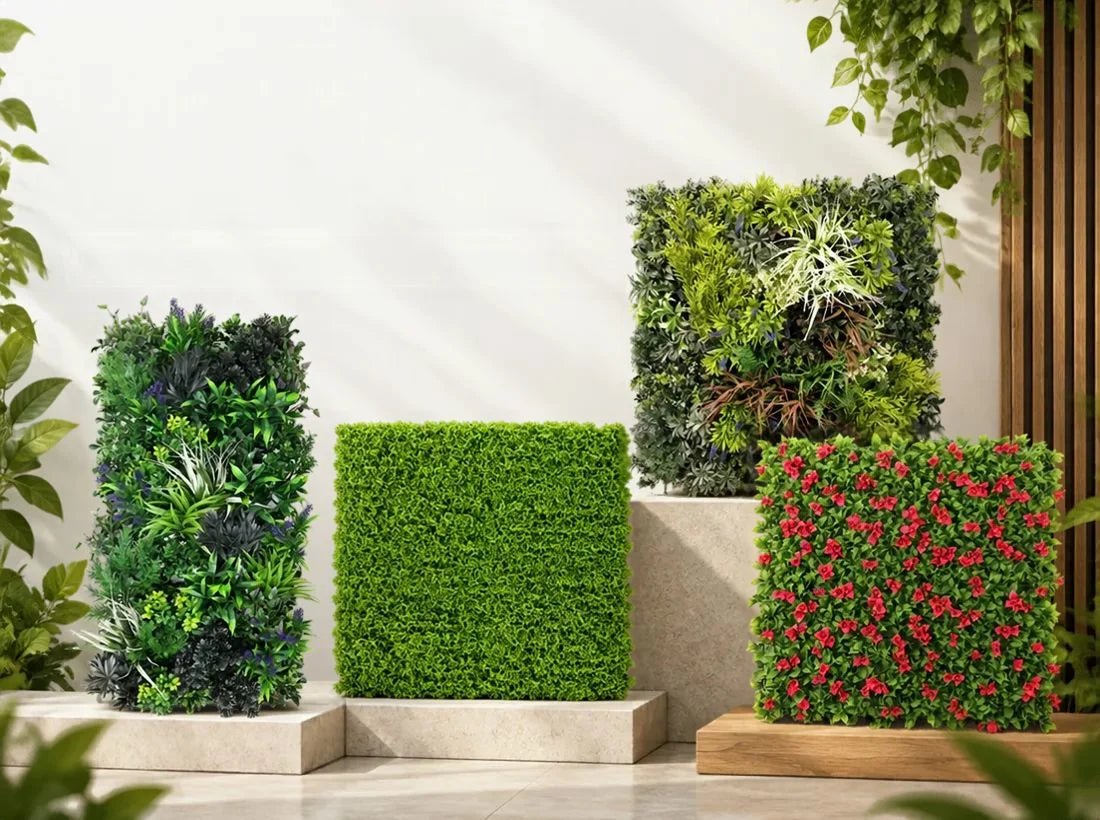
Summary: To choose an artificial green wall supplier, you need to look for a few things that denote quality, credibility, and safety, among which are: physical samples, third-party test reports, UV protection, fire documentation, and several others. If your chosen supplier is reliable, they’ll hand these over without question before you order.
You’ve found an artificial green wall that looks perfect in the render. Then the real questions start. Will the color hold on a west-facing facade? Will the property manager sign off? Will panel 200 look the same as panel one?
Most supplier websites look alike: lush photos, big claims, little proof. When you specify artificial greenery for a client (or for your own business), your name sits on the result, not the supplier’s. So in the end, you’re the one responsible for things going well (or not).
We work with architects, interior designers, builders, and trade clients every week, and we know which questions separate a reliable artificial green wall supplier from a risky one, because we’ve done our due diligence not to be one of the latter.
So, our team sat down and created a checklist they recommend using when sitting on the other side of the table, as a buyer. Run it against every one of the living wall suppliers on your shortlist (us included) to choose the faux greenery products that suit you best.
10 Things to Look for in an Artificial Green Wall Supplier
Once you’ve got a list of a few suppliers you’d consider working with, start with a list of 10 things they need to fulfil.
Depending on your project, there may be other things you’d like to ask for, but here are the most important ones for commercial projects:
1. Ask for physical samples
Photos flatter every panel, so they’re not always the best way to judge a faux green wall panel.
Ask for a sample cut from a full-size production panel, so the materials and testing match what you’ll install. Our low-cost green wall samples work exactly that way. Then, do the test that so many people skip: leave the sample where the wall will go for a full day.
Then, come around to check it in morning light, evening light, and under your own fixtures, and look closely at leaf texture, sheen, and the backing grid. This is the best way to determine if a faux vertical garden panel will fit the space.
Even if you don’t have the time to test it out for a full day, having it up for an hour will still be enough to get a good idea of placement and fit.
2. Ask for third-party test reports
Claims cost nothing, but reports cost money.
If you’re sourcing fauxliege for a space with specific requirements, like a healthcare or educational facility, ask for independent documents covering RoHS, REACH, SGS, and ISO, and read the report itself.

Check that the product name on the report matches the panel you’re ordering. If a supplier answers with adjectives instead of documents, move on. Our explainer on what each certificate proves shows you what to look for, and if you want a document to prove any of our claims, contact our team, and we’ll send it to you personally.
3. Confirm UV protection
Sun fades cheap plastic fast, and surface sprays wear off.
If you’re decorating an outdoor space that will be exposed to the sun, ask whether the UV inhibitors sit inside the leaf or on top, and what testing backs the claim.
Our UVTex technology puts the inhibitors inside the leaf, and we back it with ISO-certified UV resistance and over 5,000 hours of UV testing (which we also have reports for!). We covered a plain concrete wall facing full sun at a California commercial space with Jasmine panels and transformed a Laguna Beach spa courtyard with panels from our collection.

Both sit outdoors, so both needed outdoor-rated panels. If you’re looking for longevity, don’t skip this step.
4. Ask for fire documentation
For hotels, restaurants, retail, and public spaces, your fire marshal or building certifier will ask for proof that the decor you’re adding won’t be a fire risk.
So, be prepared and ask for the test standard and the result. If you’re buying from Designer Plants, make sure to notify our team of any requirements so we can ensure our panels meet your needs.
NFPA 701 is the main US standard for decorative materials, and that’s what our fauxliege is tested against, but we strongly recommend seeking advice from your local authority if you’re not sure whether these certificates cover you. As it stands, our team can’t advise you on fire safety matters; we can only match you with a panel that has your required specifications.

We build FireTex into the polymer instead of spraying it on, and we provide NFPA 701 documentation on request. Browse our fire-rated artificial green wall panels, or see what NFPA 701 compliance means for your space.
5. Check material safety
Ask what goes into the plastic and whether the supplier meets RoHS. A strong chemical smell out of the box is a red flag.

Our panels are non-toxic, SafeTex certified, and RoHS compliant. Spas, clinics, and kids’ spaces deserve extra care, so see what to know before you specify greenery for spas and wellness spaces.

Make sure you have all the requirements needed before you browse or shop from your supplier. Our team is always ready to help you regarding placement and fit, but we can’t tell you what kind of material you can use for a space that vulnerable people may frequent.
6. Get the warranty terms
A headline number tells you little, so you should always ask what it covers, which products it covers, how claims work, and who pays for what.
Our 5-year UV warranty covers commercial-grade green walls and hedges against excessive fade, cracking, and product failure. Metal frames carry 3 years, and individual UV-rated plants carry 12 months unless the listing says otherwise.
Claims need notice within 7 days and proof of purchase, and we resolve them with replacements or credit, not cash. Installation labor stays with you. In our experience, many suppliers offer one to two years, or nothing at all. So, if coverage is important to you or your clients, factor this in together with your other prerequisites.
7. Look at the installation system and support
A great panel with a poor fixing system means callbacks. Ask which fixings, clips, and tracks the supplier recommends for each panel and surface type, and whether they provide you with an installation guide.
Our panels clip together and trim with scissors or a utility knife, then screw, cable-tie, or staple to suit the surface. We also carry our own recommended installation parts and suggest you follow our step-by-step install guide for easy DIY installs (or as a general guide of what to expect from your professional installer team).
We can also connect trade clients with installers in California, Texas, New York, and Florida.
8. Ask about trade and spec support
Architects and builders need more than a retail checkout: trade pricing, bulk order options, spec sheets, and a contact.
We offer trade pricing and distributor accounts, with business verification and setup. Every product page includes a downloadable spec sheet you can drop straight into a submission.
9. Ask what happens at end of life
Sustainability briefs now reach most commercial projects, so ask for the recycling process in writing: who accepts the panels, where, and what happens to the material.
We run a closed-loop recycling program in participating US regions that turns used products into furniture and homewares, and we hold GRS certification.
Even when you’re done with your panels and/or plants, nobody wants to see them go to a landfill. So, thanks to this program, you can reach out to our team to coordinate sending back your products to be recycled. Our guide to how our recycling program works explains each step.
10. Verify the track record
If you’re looking for suppliers who have worked in your sector or with specific requirements, ask for completed projects, and then check them.
Browse our project gallery to get a sense of what our team has done for commercial spaces in many industries and what you can expect to see. Ask every supplier for a reference on a project installed several years ago, because that’s where durability shows.
Better still, visit a showroom and handle the product yourself if possible. You can visit our warehouse showrooms in Florida and California by appointment to get a sense of our expertise and product quality. We’d love to see you there!
Finishing Thoughts
The best artificial green wall supplier makes your job easier. They answer all your (hard) questions quickly, hand over documents without a fight, and stand behind the product in writing.
If a supplier hesitates on some of these points, you’ve already learned what you need to know.
We’d love to earn a place on your shortlist.
Book a free consultation, and we’ll review your brief, or visit our Florida or California showroom and put every panel through your own inspection.
FAQs
-
What should I check first when choosing an artificial green wall supplier?
-
Start with samples and third-party test reports. Together they show whether the product matches the pitch before you spend on anything else.
-
How long should an artificial green wall warranty last?
-
For outdoor commercial-grade walls, look for a 5-year warranty covering fade and cracking. Then read the tiers, claim steps and exclusions.
-
Do living wall suppliers offer samples?
-
Reputable ones do. Ask for samples cut from production panels, not specially made showpieces.