
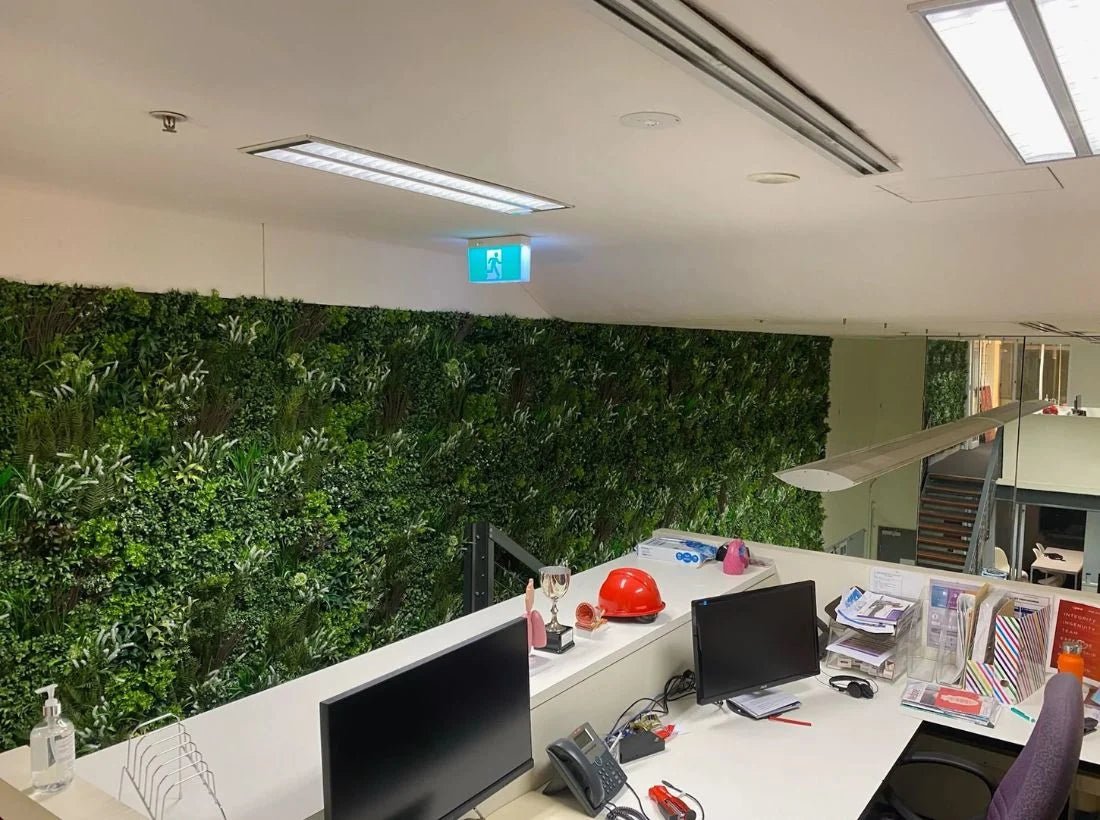
Let's be direct about something: a faux green wall is not going to transform test scores. Anyone selling it to a school administration on that basis is overselling it, and we won't do that.
What we will tell you from 20+ years of delivering artificial greenery into commercial environments, including clinical-adjacent spaces, high-traffic public interiors, and venues that need to look good every day, is that a correctly specified green wall in the right location of a school does several useful things.
This guide covers those things and helps you understand where faux green walls belong in a school, where they don't, and what the certification requirements mean for a school building.

We’ll also touch on how we've handled the installations that many suppliers won't touch: the hard-to-access spaces that make school sites particularly interesting to work in.
Where Artifical Green Walls Work in a School
While faux green walls are a set-it-and-forget-it decor piece wherever you put them, they still work best in specific spots. And thanks to our 2 decades of experience, we can tell you exactly which spots those are:
Reception and main entry
If you want to make a strong first impression, install your artificial green wall in the reception or the main entry. The reception is the zone that parents, prospective families, and first-time visitors form their impression of the school from, and that often happens before they've spoken to a single person.
A lush green wall in a school reception does what no painted wall or motivational poster can: it communicates that someone thought carefully about this space.

It also photographs well. For independent schools and charter schools competing for enrolment, the entrance experience is a great differentiator, and a green wall behind a reception desk or along the main corridor becomes the image in the brochure, the background of the open day photo, and the screenshot on the admissions page. In a way, it’s a marketing argument with a one-time cost.
Our zero-maintenance green wall office and commercial installation is the best documented example of what a reception green wall does for the overall atmosphere of an interior, and the same principle applies directly in a school entry context.
Perimeter fencing and boundary walls
Chain-link and metal mesh perimeter fencing is one of the most visible and consistently under-addressed elements of a school campus. It's functional, it's necessary, and it looks like it.
Attaching artificial green wall panels or boxwood hedge panels to the perimeter fence face transforms the boundary from a chain-link fence into a green, lush border, without structural modification, without drilling, and without any permanent change to the fence itself. Panels attach with UV-rated cable ties through the panel grid, so there’s no extra effort needed.
For schools, there's a safeguarding dimension here too. A dense panel along the boundary fence makes it harder to observe students at play from the street, creates a visual buffer, and signals that the school has invested in its site.
Cafeteria and common spaces
High-traffic common spaces like cafeterias, hallways, and covered walkways, are where a green wall can make the biggest mood impact for the largest number of students daily. A feature green wall in a cafeteria changes how students experience the space, softens an otherwise institutional feel, and creates a visual anchor that makes the room look intentional.

The specification priority in these spaces is SafeTex certification and material safety. The practical priority is durability: these are high-contact zones, and the panels need to be robust enough to handle proximity to thousands of students without needing replacement within a couple of years.

Our Lush Fern panel and Country Fern panel are the two we reach for most often in common space installations becaude their foliage depth looks premium from a distance but holds up at close inspection.
Shaded and hard-to-plant courtyards
Inner-city and dense-campus schools frequently have shaded internal courtyards, light wells, and covered outdoor spaces where live planting either fails immediately or requires infrastructure that many school budgets can't support.
Artificial panels require no light. A fully shaded interior courtyard covered on 3 sides by a building performs exactly as well as a south-facing fence in terms of panel performance and color retention.
For panels in exposed outdoor courtyards that receive UV, we always specify UVTex-rated products with inhibitors integrated within the leaf. Our outdoor UV-resistant range covers every courtyard and outdoor application type.
The Certification Requirements That Matter for Schools
School are subject to strict certification requirements to account for the health and safety of their students and staff. Here’s which certifications matter most for your school project:
NFPA 701 fire rating
Any decorative material installed in a public-occupancy school building in the US should be evaluated for fire compliance. NFPA 701 (National Fire Protection Association) is the standard test method for evaluating the fire resistance of decorative materials. Our FireTex range carries NFPA 701 certification from independent laboratories, with test reports available on request before any order is placed.
The distinction that matters: fire-retardant compounds are integrated into our FireTex panels at the polymer level during manufacturing. For any school installation in a covered interior space, particularly hallways, cafeterias, and reception areas, NFPA 701-compliant panels are the specification we recommend as a baseline.
Confirm the applicable requirement with your fire engineer or building certifier before ordering. Fire codes vary by state, building class, and occupancy type. We provide FireTex documentation to support that confirmation, so contact our team to request it.
SafeTex non-toxic certification
Many artificial plant manufacturers use materials that contain heavy metals or volatile organic compounds. For a space where children spend seven or more hours a day, that's a health consideration.
Our SafeTex certification covers non-toxic material composition and contains no VOC off-gassing. SafeTex documentation is available for any order where the school or district procurement team requires it. For schools specifically, we always recommend confirming SafeTex compliance before specifying, and we always have that documentation ready to go.
Hard-to-Access Spaces: What Happens When Standard Installation Doesn't Work
School buildings are architecturally varied in ways that create installation challenges.
We've installed green walls in spaces like these. The approach is the same as the one we use in any hard-to-access residential or commercial space: plan the access before planning the panels.
For any installation that requires working above head height, our team assesses the access constraints during the initial consultation and factors the appropriate approach into the project plan.
The key thing that makes school installations specifically worth planning carefully: school sites are active. Students, staff, and visitors are present during the school day. Installation scheduling needs to account for this so that disruption to circulation routes is minimized. We plan all of this in the consultation phase.
Product Recommendations for School Applications
-
Reception and entry: White Oasis panel for a refined, premium-quality backdrop. Mixed botanical panels for a warmer, more naturalistic feel.
-
Cafeteria and common areas: Lush Fern or Country Fern for foliage depth that holds up at close range in high-traffic zones.
-
Perimeter fencing: Dark Boxwood panel or Mixed Boxwood panel for formal, structured fence coverage. UV-rated outdoor specification required.
-
Shaded courtyards: Lush Spring for brightness in low-light environments. Multiple species panels for visual interest in spaces where students spend significant time.
-
Hallways and corridors: Amazon Jungle panel for high-drama, high-impact corridor features.
Browse our full commercial green wall range for the complete specification options, and use the Panel Finder Quiz to narrow down options before requesting samples.
Finishing Thoughts
A school artificial green wall isn't a silver bullet for anything. But in the right location, with the right product specification, and with the right certifications in place, it's one of the most cost-effective ways a school can improve the visual quality of its environment permanently, without adding a single ongoing obligation to the facilities team.
We've been doing this long enough to know which applications work and which don't. We're also the team that will tell you honestly when a green wall isn't the right call for your situation because we don’t want you to get it wrong.
If you're a facilities manager, an administrator, or an architect working on a school project, the right starting point is the same as any commercial brief: a free consultation, a site assessment, and a clear picture of what the installation would involve before you commit to anything.
FAQs
-
Do school green walls need NFPA 701 fire certification?
-
For any covered interior application in a public-occupancy school building, NFPA 701 compliance is the standard we recommend as a baseline specification. Requirements vary by state and building type, so always confirm with your fire engineer or building certifier. Our FireTex range carries independent lab certification with documentation available on request.
-
What is SafeTex and why does it matter for schools?
-
SafeTex is Designer Plants' non-toxic material certification that encompasses ISO, REACH, and RoHS compliance and materials free from lead, heavy metals, allergens, pollen, and VOCs. In a school environment where children spend extended time in proximity to wall surfaces, material safety certification matters. Documentation is available on request for any order.
-
Can artificial green walls be installed on school perimeter chain-link fencing?
-
Yes. Panels attach to chain-link with UV-rated cable ties, so you don’t need permanent fixtures or drilling. For outdoor perimeter fencing, UV-rated panels with integrated UVTex inhibitors are the required specification in any high-UV geography.
-
How do you handle installation in an active school?
-
We schedule around the school calendar or in phased zones to minimize circulation disruption. Access requirements for elevated walls (scaffolding, platform staging) are planned in the initial consultation.
-
Are artificial green walls better than living walls for schools?
-
For most schools, yes, because living walls require weekly horticultural maintenance, irrigation infrastructure, and specialist access that most school budgets and facilities teams can't sustain. Artificial panels deliver the visual and wellbeing benefit without any ongoing maintenance obligation after installation day.
-
How long will a school artificial green wall last?
-
Indoor commercial installations using our panels are expected to perform for 15+ years. Outdoor UV-rated panels carry a 5-year UV warranty. FireTex fire-resistance properties are integrated at the polymer level and don't degrade with time or cleaning.