
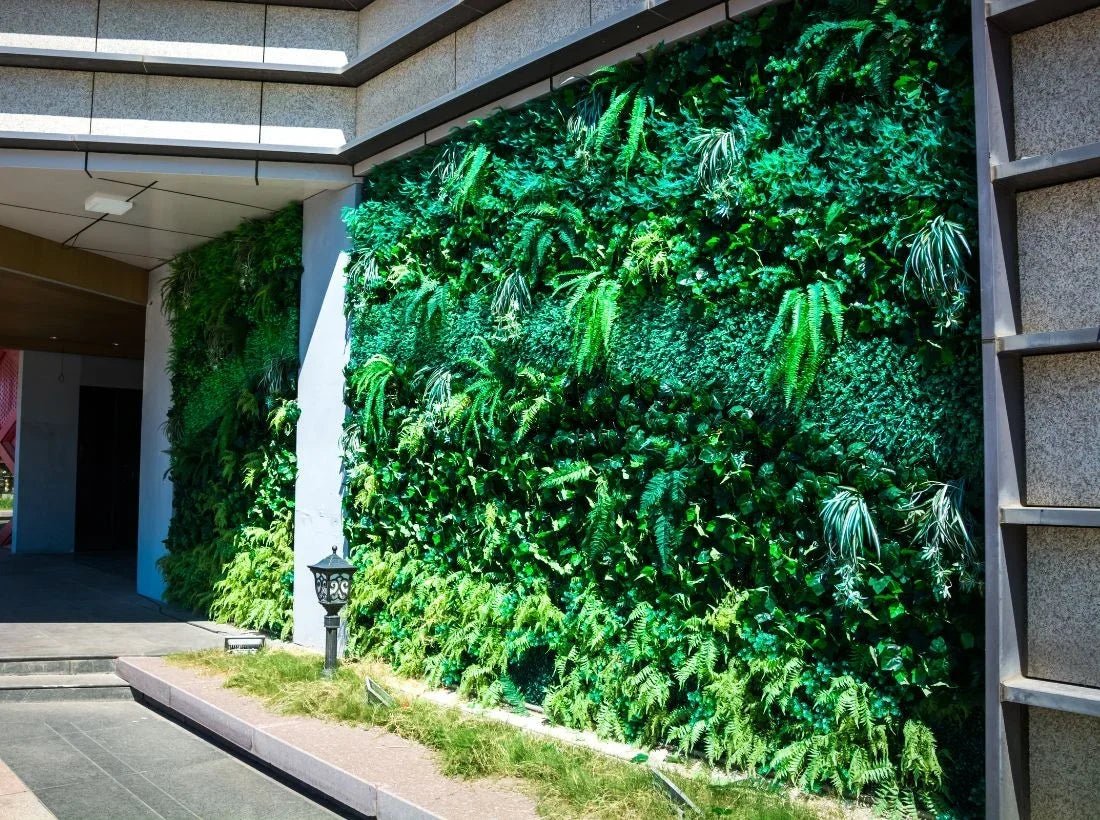
The outdoor spaces that use artificial plant wall panels convincingly share one characteristic: the panels aren’t the most important decor element. Instead, that’s the stone, the water, the steps, the tables.
The faux greenery does what good softscape should do in a landscape - blend in without taking all the attention for itself.
Getting there requires the same decisions a landscape architect would make about where planting sits relative to hard materials, how foliage scale relates to the surrounding elements, and where a panel should give way to something else entirely.
The fact that the panels are artificial changes the product specification, but it doesn't change the design logic. These are the principles our team at Designer Plants applies, and we’ll go over them in this guide to give you all the tools to execute such a project well.
How We Blend Artificial Panels With Living Plants: 3 Techniques
The transition between artificial and living greenery is where outdoor installations succeed or fail. Our team often follows 7 decorating tricks to make fake plants look more realistic, but sometimes, a few tactics aren’t enough to make fauxliege look like it belongs in a space.
Here’s what we do to ensure there’s a smooth transition:
Start with the problem
The most consistent mistake in outdoor artificial panel installations is leading with product selection. Unfortunately, it’s the issue we see most often for residential and commercial installations.
When you have a vision in mind, before you look at a panel style, you need to establish what the surface needs to solve and what it needs to support.
For example, we recently completed a beautiful project in South Carolina. The client had retaining walls beside their step and a vertical face of a water feature planter. This comes with a specific design role: the panel needs to be a transition element that complements the surrounding environment. Therefore, the panel choice, the density, the edge treatment, and the relationship to surrounding materials all follow from that role.
Here’s what our team says about outdoor green walls:
“The most common applications are residential feature walls, pool surrounds, restaurant and café interiors, retail backdrops, and outdoor commercial installations. But we can’t ignore any other vertical surface in a landscape that's prominent, yet too challenging to plant conventionally.”

While there are hundreds of ways to use artificial plant walls, ensure you’ve got the full picture of your space before anything goes on the wall.
-
Measure the surface, including returns, corners, and any interruptions.
-
Identify pipes, drainage outlets, lighting fixtures, and any maintenance access points that must remain unobstructed.
-
Repair unstable surfaces and address any moisture issues before panels go up
Our full outdoor installation guide covers substrate preparation for masonry, timber, metal mesh, and fencing, so check that out during the process.
Match the visual language
We didn't try to match species to the space, but the palette and the scale. The Lush Fern panel is the product we reach for most often in garden-adjacent installations precisely because its leaf form appears throughout established American gardens. In many ways, panels like these look native to parts of the US.

The Country Fern panel carries a slightly different texture that suits more naturalistic, less formal garden contexts, so it’s also a go-to for many of our customers.
We went through this step for our most recent outdoor spaces, too. The retaining wall installation beside the stone staircase works because the panel foliage speaks the same language as the Japanese maple, the river rock ground covers, and the surrounding woodland planting.

Our team and the client started with the space first, not with the visual appeal of the panel itself (which also makes it much easier to pick, as all panels have their unique charm).
Vary depth across the surface
If we’re to install a single-species panel uniformly across a surface, it might look like a printed surface. In the stone staircase installation, we used a mixed botanical panel that creates tonal and textural variation across the face, then added a small number of hanging stems woven through sections of the panel to introduce projection and shadow.
This is the technique our Mediterranean poolside project used to full effect: stems trimmed and threaded through fern panels to create bursts that broke the uniform surface. It takes twenty minutes, and it makes all the difference.

If you don’t want to enrich your panel with artificial stems, you can also add other accessories to it for some character.
Ongoing Maintenance of Outdoor Panel Installations
Outdoor panels are low-maintenance, but not always zero-maintenance, especially not when they’re outdoors and around water and dust. So, every few months, we recommend inspecting the artificial plant wall panels for a buildup of dust or any damage from inclement weather. If everything looks great, you just need a gentle wipe-down and, if applicable, a fresh coat of UV spray.
Many of our faux green walls come with 5-year warranties, but if you’re specifically interested in this, please talk to our team beforehand so we can assist you as best we can.
Other things you’d best keep in mind:
-
Check fixings after severe weather
-
Prune living plants that grow against the panel to avoid them pushing against the fauxliege
-
Keep drainage paths below and around panels clear
How to Integrate Panels With a Water Feature or Pond
Since high-quality artificial green walls are weather-resistant and can handle a good amount of splashes, it makes them a good option for projects around a water feature, a pond, or a pool. The vertical surfaces surrounding a pond, fountain, or recessed water planter are almost always too wet, too shaded, or too structurally constrained for conventional planting, so there’s not much you can do here.

With such projects, we treat the panel surface as the background the water flows against; it should not compete with it as a feature. Keep the foliage below the coping or cap line so the material creates the top edge, and the panel foliage fills the wall face below it. This lets the hard landscaping anchor the installation and prevents the greenery from fighting the surface for visual dominance.
The fixing details matter more here than anywhere else in an outdoor installation. Use stainless steel or hot-dip galvanized fixings throughout because standard zinc-plated screws may rust when close to water. Leave an air gap behind the panel backing to allow drainage and prevent moisture and organic debris from accumulating between the panel and the wall.
Keep panels well clear of the water body itself and ensure they don't obstruct pump housing, filter access, or overflow routes. Where pond lighting or pump electrics are nearby, confirm clearance distances with a licensed electrician before installation.
How to Use Panels as a Dining Backdrop
The principle for a covered outdoor dining space is different from every other application because the primary audience isn't the homeowner looking at the wall, but the guest who sees the space for the first time and forms an impression within seconds.
The most effective approach for these spaces is to build in layers. The panels provide the consistent base. In front of it, introduce a small number of living plants: a fiddle-leaf fig in an oversized planter, a large-leafed tropical in a terracotta urn, or anything else that’s caught your eye.
Living plants will introduce organic variation, seasonal movement, and a loose, irregular silhouette that’s easy on the eye and makes the backdrop look much more balanced. We also love seeing sculptural elements in the middle ground to bring in more depth between the dining tables and the back wall.
Panel choice for outdoor dining backdrops should consider evening lighting conditions specifically. The White Oasis panel carries white floral accents that catch warm pendant or lantern light in evening service, so we love offering that for spaces like these.
The covered restaurant terrace shown here uses this panel to create variation across the backdrop that prevents it reading as a single flat surface.

For the practical details: keep all foliage clear of overhead heaters, pendant light fixtures, and food service equipment. For any covered commercial outdoor dining space, fire compliance requirements apply, and our FireTex NFPA 701-certified range is the specification we use as a default for commercial hospitality environments, with independent lab documentation available on request.
Finishing Thoughts
An outdoor artificial panel installation that looks like a part of the landscape isn't a function of any single decision, but the result of specifying for the exposure conditions, choosing foliage that speaks the language of the surrounding planting, detailing the transitions at coping lines and ground level, and making layout decisions that prevent the grid from showing.
The projects we looked over in this piece all demonstrate the same underlying principle: panels that work outdoors are ones where the design logic was applied before the first panel went up.
If you're planning an outdoor installation and want a product recommendation specific to your site conditions, landscape context, and visual brief, our team can help with a free consultation.
Or, if you’re in Florida or California, you can book an appointment for our warehouse showrooms there and see the panels in person.
FAQs
-
Which artificial panels work best alongside established garden planting?
-
Panels with multi-species foliage compositions work better in garden contexts than single-species uniform panels. The Lush Fern, Country Fern, and Jasmine panels carry leaf forms that appear in established American gardens and look like they’ve always belonged there. Mixed panels with tonal variation across the face work best because they add depth and mimic the appearance of a thriving garden.
-
Can I install the panels on a retaining wall that has a stone coping cap?
-
Yes. You should install from the coping down, trimming the top panel row to follow the coping profile. The coping creates the natural top edge, and the panel face fills the wall below it. Conceal the bottom fixing line with river rocks, mulch, or low border planting at ground level.
-
What fixings do I need near a pond or water feature?
-
Stainless steel or hot-dip galvanized fixings throughout. Standard zinc-plated fixings rust at water feature proximity within one season. Leave an air gap behind the panel backing for drainage, keep panels clear of the water body and pump access, and confirm electrical clearance distances with a licensed electrician.
-
Do commercial outdoor dining spaces need fire-rated panels?
-
For covered commercial outdoor dining areas, fire compliance requirements vary by state and building type. Our FireTex range is NFPA 701 certified with independent lab documentation available on request, and we use it as a default specification for all commercial outdoor hospitality environments. In any case, we implore you to confirm requirements with your building certifier before picking panels.