
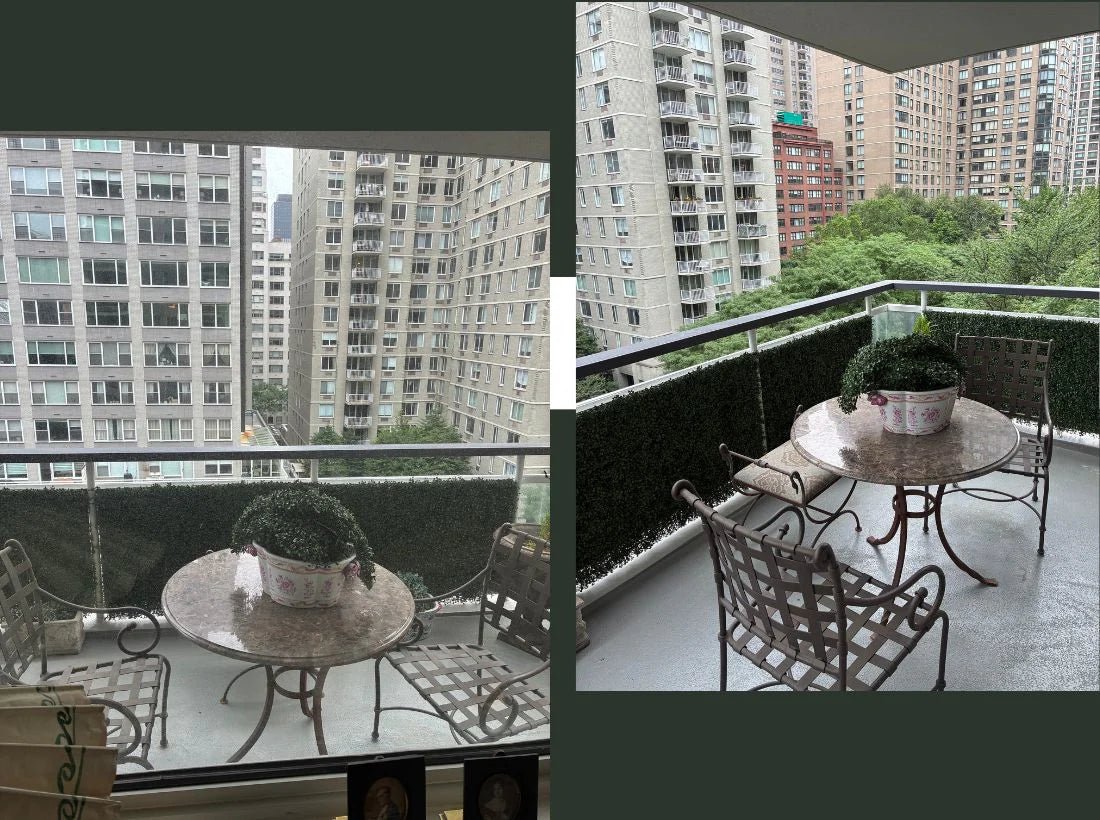
Por fin tienes un espacio al aire libre.
Un balcón, una terraza, un rincón en la azotea, un lugar que podría ser una verdadera extensión de tu hogar. Y ahora mismo es una losa de hormigón con una barandilla, vistas completas a los vecinos y nada que crezca porque no tienes tiempo, la luz adecuada o la paciencia para ver morir una planta de verdad antes de que alcance la altura de cribado.
Esta es la situación para la que se diseñó el boj artificial (o eso nos gustaría pensar).
No está hecho para ser un compromiso, sino una solución mejor. Aquí te explicamos cómo abordarlo correctamente, qué productos funcionan a escala de balcón y cómo es la transformación en la práctica.
Sigue leyendo para conocer los detalles.
Por qué el boj artificial funciona tan bien en balcones
Para algunos estadounidenses, relajarse al aire libre solo es posible en el balcón.

Sin embargo, a veces, los vecinos curiosos siguen entrometiéndose en el precioso tiempo que tienes para ti. El boj artificial lo resuelve de manera diferente a otras opciones de vegetación artificial, y las razones son específicas de lo que exige un entorno de balcón:
-
Tolera lo que los balcones le lanzan: Certificado UV para instalación permanente en exteriores, respaldado por una garantía UV de 5 años. Dado que nuestros paneles utilizan inhibidores UVTex integrados en la hoja, no aplicados en la superficie, el color se mantiene con pleno sol, aire salino y cambios de temperatura que degradarían rápidamente una alternativa recubierta en superficie.
-
No requiere nada después del día de la instalación: sin riego, sin poda, sin reemplazar secciones muertas, sin mantenimiento estacional. Una vez instalados, nuestros paneles de boj artificial requieren muy poco (o casi ningún) mantenimiento. Tus plantas no sufrirán si están fuera de la vista y de la mente.
-
Parece bien pensado, no improvisado: los paneles de boj crean una superficie botánica de variedad y profundidad naturales gracias a su variación tonal y textural que produce una pared que se lee como orgánica.
Ideas de diseño de balcones con paneles de boj artificial
Si bien hay cientos de maneras de decorar un balcón con plantas artificiales y paneles de pared verde, aquí están algunos de los favoritos infalibles de nuestro equipo:
-
Pantallas de privacidad a lo largo de la barandilla
Monta paneles a lo largo de la cara interior de la barandilla de tu balcón. Puedes fijarlos con bridas a través de la rejilla del panel y rodear la barra de la barandilla para crear un límite verde instantáneo que protege de los balcones vecinos y suaviza la línea dura de la barandilla desde el nivel de la calle. Así es como nuestra cofundadora Georgina recomienda instalarlo:
Para esta aplicación, nuestros paneles Dark Artificial Boxwood Wall son la elección más frecuentemente especificada. El verde oscuro y profundo resalta bellamente contra el revoque claro y los muebles de exterior pálidos, y la densidad significa que no hay huecos visibles una vez que ajustas el follaje a mano después de la instalación.
Para una barandilla que no alcanza la altura de protección completa por sí sola, puedes añadir la tira de seto artificial de boj oscuro a lo largo del borde superior para extender la altura de privacidad sin reemplazar toda la hilera de paneles.
-
Una pared decorativa detrás de tus asientos de exterior
No todos los problemas del balcón se refieren a la privacidad. A veces, el problema es que no hay nada que mirar: es posible que tengas una extensión ininterrumpida de pared o pantalla que no le da al espacio exterior ningún punto focal ni ninguna razón para sentarse y quedarse.
Una instalación de paneles de boj en la pared detrás de un grupo de asientos soluciona esto de inmediato. Dos o tres paneles detrás de un sofá exterior o un par de sillas crean un exuberante telón de fondo botánico que ancla la zona de asientos y hace que todo el balcón se sienta como una habitación exterior bien pensada.

Para este uso de estilismo, el Panel de Jardín Vertical Artificial de Boj Mixto es una excelente opción porque su variación tonal entre verdes más claros y más oscuros crea una profundidad que un panel de un solo color no puede replicar, y se ve particularmente bien con la luz natural.
-
Macetas de boj independientes para una zonificación flexible
Si no puedes o no quieres montar nada en la pared o la barandilla, nuestras macetas de boj y setos independientes ofrecen una alternativa sin necesidad de fijación. Son unidades autónomas que combinan follaje y maceta, están estructuralmente lastradas para la estabilidad exterior y se pueden reubicar cuando quieras cambiar la distribución.

Funcionan particularmente bien como divisores de zona en terrazas más grandes, o como un par que enmarca una entrada o un paso al balcón. Para los balcones de apartamentos donde perforar paredes o barandillas no es una opción, las macetas independientes son el punto de partida práctico, y se pueden complementar con tramos de paneles más adelante.
-
Mezcla de boj con otra vegetación
La estructura y la consistencia del boj lo convierten en una capa base ideal para un esquema de balcón, pero funciona aún mejor cuando se combina con otros elementos.

Un telón de fondo de panel de boj con una planta colgante en cascada en la parte delantera, o una maceta independiente flanqueada por dos palmeras artificiales o tallos de bambú más altos, crea el tipo de profundidad en capas que hace que un balcón se sienta como una habitación al aire libre.
Estilo exterior de bajo mantenimiento: qué hace diferente al boj artificial
La conversación honesta sobre la vegetación exterior real es esta: la mayor parte requiere más cuidado de lo que nadie tiene tiempo para darle.
Un seto de boj real necesita ser podado un mínimo de dos veces al año, regado regularmente y protegido de la plaga del boj (una enfermedad fúngica que puede dejar un seto maduro sin hojas en una temporada). Las pantallas de bambú se deforman. Los celosías de madera se pudren. Los paneles de privacidad de tela se desvanecen.
La decoración exterior nunca es tan fácil como parece.
Sin embargo, los paneles de seto de boj artificial facilitan un poco las cosas. Pueden convertir una valla, balcón o pared exterior desnuda en una densa pared de color verde perenne, con la arquitectura formal de un seto mantenido profesionalmente, sin la poda, el riego ni la espera de años de crecimiento.
La garantía UV de 5 años que respalda nuestros paneles significa que la retención del color es un compromiso documentado, y si no cumple con lo prometido sin que sea culpa tuya, podemos respaldarlo. Como tal, esta es una inversión única que supera a todas las alternativas estacionales que de otro modo tendrías que reemplazar anualmente.
Recomendaciones de productos para proyectos de boj en balcones
El producto adecuado depende de tu balcón específico, incluyendo el tipo de barandilla, la superficie de la pared, la exposición al sol y cuánto del perímetro deseas cubrir. Estos son los productos que más comúnmente recomendamos para aplicaciones en balcones (y los que los clientes como tú especifican con mayor frecuencia):

-
Panel de pared de boj artificial oscuro — 40×40 pulgadas, 11 pies cuadrados: El panel de balcón más especificado. Verde oscuro, denso y certificado UV. Funciona como pantalla de barandilla, pared decorativa o fondo de asiento.

-
Panel de jardín vertical artificial de boj mixto — 40×40 pulgadas, 11 pies cuadrados: Para balcones donde prefieres un aspecto más naturalista y menos uniforme. La variación tonal entre los paneles crea una profundidad orgánica, que es particularmente efectiva con la luz natural.

-
Panel de jardín vertical artificial de boj natural — 40×40 pulgadas: Un tono verde más claro y brillante que es particularmente eficaz en balcones con luz limitada, donde los paneles más oscuros se ven pesados. Una estética limpia y fresca que se adapta al estilo de apartamentos contemporáneos.

-
Tira de seto artificial de boj oscuro — 40×10 pulgadas: Para añadir altura a lo largo del borde superior de una barandilla o panel existente. Se coloca en minutos y añade la altura extra de pantalla de privacidad que a menudo le falta a una barandilla de altura estándar.

-
Macetas de boj y setos independientes: Para balcones donde el montaje de paneles no es posible. Pesados para estabilidad exterior, resistentes a los rayos UV y reposicionables cuando se cambia el diseño.
Explora la colección completa de paneles de seto artificial de boj para comparar la gama completa y elegir la mejor opción para tu espacio.
Para más inspiración de estilo, echa un vistazo a las poco conocidas 7 formas en que los setos de boj artificial aumentan la privacidad y la seguridad. También puedes encontrar tu opción ideal siguiendo las recomendaciones de nuestros estilistas sobre los 3 mejores tipos de setos artificiales.
Reflexiones finales
Un balcón en el que valga la pena pasar tiempo no es un gran proyecto. Es una serie de decisiones pequeñas y bien elegidas, de las cuales no puedes saltarte la hilera de paneles de boj a lo largo de la barandilla. Un panel de boj artificial te brindará privacidad, carácter y vegetación en una tarde, sin necesidad de mantenimiento posterior.
Si no estás seguro de qué producto se adapta a tu barandilla, pared o diseño específico, o si estás trabajando en una terraza comercial más grande o un proyecto de hostelería, nuestro equipo está aquí para ayudarte a resolverlo antes de que hagas tu pedido.
Ponte en contacto con Connie y Will, nuestros estilistas de plantas expertos, para una consulta gratuita y asesoramiento personalizado para tu balcón. Y mientras tanto, síguenos en nuestras redes sociales para inspirarte y educarte semanalmente sobre plantas artificiales.
Preguntas frecuentes
-
¿Se pueden utilizar paneles de boj artificial en la barandilla de un balcón de apartamento?
-
Sí. Los paneles se sujetan a las barandillas metálicas con bridas a través de la rejilla integrada del panel. Este es el método de instalación más común para los balcones de apartamentos y es completamente reversible si estás alquilando.
-
¿Se desvanecerán los paneles de boj artificial con la luz solar directa?
-
No con paneles certificados UVTex. Los paneles de boj de Designer Plants utilizan inhibidores UV integrados en el material de las hojas durante la fabricación y están respaldados por una garantía UV de 5 años que cubre la retención del color.
-
¿Cuántos paneles necesito para una barandilla de balcón estándar?
-
Cada panel mide 40×40 pulgadas y cubre 11 pies cuadrados. Mide la longitud de tu barandilla en pulgadas, divídela por 40 y redondea para encontrar la cantidad de paneles. Por ejemplo, una barandilla de 10 pies (120 pulgadas) necesita 3 paneles. Añade un panel adicional para recortes en esquinas o extremos. También puedes usar la calculadora de paneles en cada página de producto para obtener una medida precisa.
-
¿Puedo cortar los paneles para adaptarlos a los obstáculos de la barandilla?
-
Sí. Puedes cortar todos los paneles con tijeras a lo largo de la rejilla de soporte para adaptarlos con precisión a cualquier dimensión, obstáculo o esquina.
-
¿Son los paneles de boj artificial adecuados para balcones costeros o con mucho viento?
-
Sí. Los paneles de LDPE con certificación UV son resistentes a la intemperie y a las heladas. Para balcones con mucho viento, aumenta el número de bridas o tornillos por panel y utiliza el sistema de entrelazado de lengüeta y orificio entre paneles adyacentes para reducir el movimiento en las uniones.
-
¿Necesito un instalador profesional?
-
No es necesario, pero puedes trabajar con un profesional si quieres. Los paneles de Designer Plants están diseñados para una fácil instalación por ti mismo porque puedes encajarlos, atarlos con bridas o atornillarlos, según la superficie. Nuestra guía de instalación paso a paso cubre cada tipo de superficie con videos de referencia. Sin embargo, si estás abordando un proyecto más complejo, es posible que necesites buscar ayuda profesional.