
If you're designing or refitting a gym or fitness studio and you're thinking about greenery, you're making the right call.
Biophilic design in fitness spaces is well past the trend stage because it's now backed by research, member expectations, and a very clear commercial argument for member retention. The only real question is which type of greenery works in a gym environment.
We'll save you some time: live plants don't.
Not consistently, not at scale, not in the conditions a fitness operation creates.
But artificial green walls do, and we've installed them in these environments successfully over the last 20 years. Here's the breakdown of why, and what to consider before you buy anything.
Why Gyms Are a Hard Environment for Live Plants
There are a few different reasons why gyms can be a tough space for live plants.
The temperature swings alone are the problem. Most fitness spaces run cold through air conditioning between sessions, then shift to warm and humid as rooms fill with people working out.
Back-to-back classes mean repeated temperature cycling throughout the day and very little consistency, conditions live plants dislike.
Add recirculated air (dry, filtered, chemical-treated), typically low natural light in basement gyms and windowless studios, and a cleaning regime designed around sweat and hygiene, and you have a set of conditions that reliably produces patchy, struggling, eventually removed live planting.
We've seen this because we’ve gotten calls from gym owners who installed live plants and now need a permanent solution.
The reasoning is always the same: great idea, wrong product.
The Research Case: Greenery, Exercise Enjoyment, and Member Retention
A growing body of evidence links natural visual environments to exercise experience, and that's why the commercial argument for biophilic design in fitness spaces is stronger than it first appears.
Researchers found consistent improvements in mood and self-esteem from physical activity in green surroundings. That research was primarily outdoors, but the follow-up question for indoor fitness design is whether bringing natural elements inside creates a similar effect, and researchers are now studying that directly.
A study on biophilic design in sports and fitness facilities found that incorporating natural elements was associated with greater exercise immersion and improved psychological resilience among users.
More specifically, Colorado State University is currently running a controlled clinical trial comparing treadmill performance, heart rate, perceived exertion, and oxygen consumption between a biophilic gym environment and a standard one, to test whether natural elements in a workout space measurably affect performance and enjoyment.
We'renot saying a faux green wall will make your members lift more weight. What the research supports is that environments with natural elements make exercise feel more enjoyable and less effortful, and that has a direct line to the metric that matters most for a fitness business: whether members keep coming back.
A member who enjoys their experience enough to show up consistently is worth more than a member who churns after 3 months. If a green wall installation costs less than the lifetime value of the members it helps retain, the ROI calculation is straightforward.
What We Install in Gym and Fitness Environments
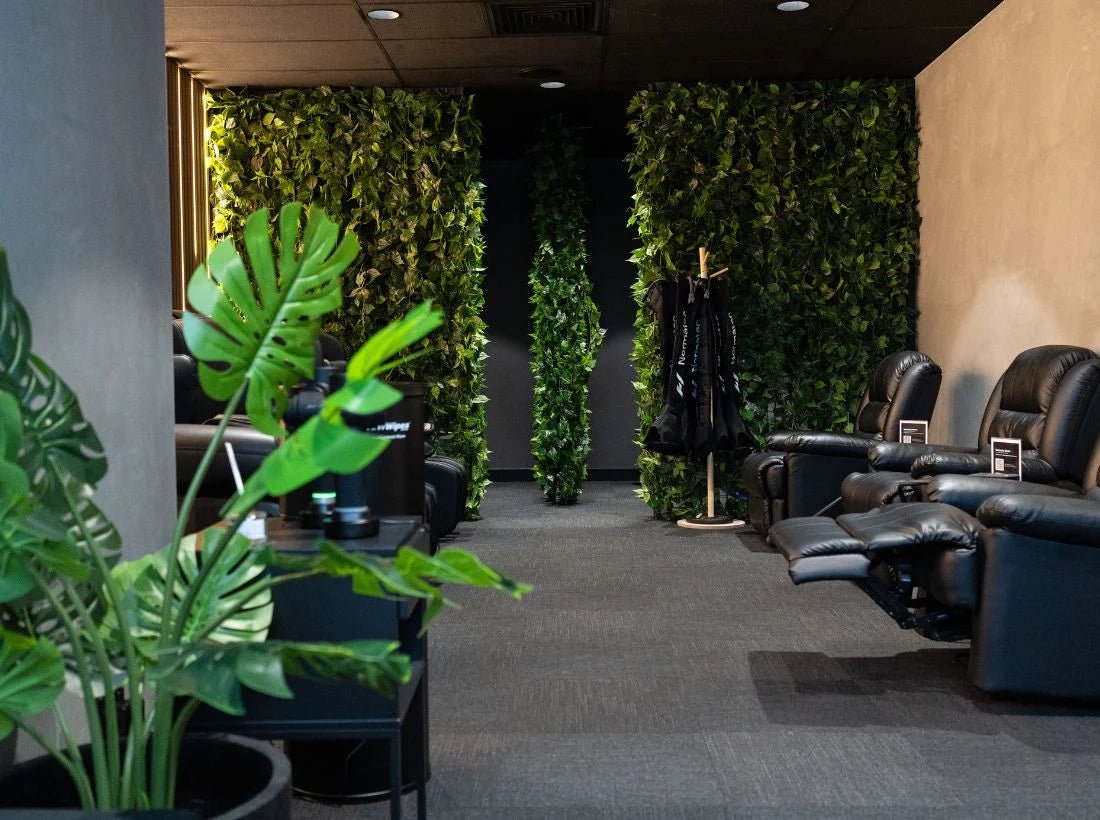
Recently, our expert team undertook a comprehensive gym transformation project, which is a useful illustration of how artificial greenery solves specific problems in a fitness environment.
In the main training and relaxation space, we installed Lush Boston Ivy panels floor-to-ceiling along the structural column faces, creating a consistent green vertical boundary between seating zones and training areas. Monstera plants in black planters sit in front of the panels at key positions, adding depth and the kind of loose silhouette that works wonders for a space like this.
In the lobby and divider zones, we used a custom boxwood planter on a gabion stone base. This is one of our favorite approaches for fitness spaces: the boxwood gives the space a formal quality, while the gabion base sits naturally in an industrial aesthetic. It creates a zone separator and a reception feature simultaneously, takes up minimal floor space, and requires nothing from the facilities team.
For the training floor planter dividers, we built long trough planters with artificial ferns that cascade over the edge and down the side of the planter, softening the hard boundary between equipment zones.
Check out what that looks like:


Fire Safety: The Specification You Can’t Ignore
Gyms are high-occupancy commercial spaces. Depending on your state, building class, and local code, decorative interior materials in high-occupancy spaces may require fire-resistance certification. If you're specifying a green wall for a gym and this hasn't come up yet, it needs to.
Our FireTex range carries NFPA 701 certification from independent laboratories. To make these faux plants, fire-retardant compounds are integrated into the material at the polymer level during manufacturing.
NFPA 701 certification documentation is available on request before you place an order. But before you do so, please confirm your requirement with your fire engineer or building certifier.
Hygiene and Acoustic Benefits of Artificial Greenery
Ideally, you clean your gym aggressively and frequently. Any decorative material on the wall of a fitness space needs to tolerate regular wiping with commercial cleaning products. To address this, we offer SafeTex-certified panels that are non-toxic, free from lead and heavy metals, REACH and RoHS-compliant, and fully wipe-clean compatible.
Besides this, gyms are loud. Artificial foliage panels absorb and diffuse sound, which can reduce the echo in rooms that would otherwise feel like a reverberant box. This isn't a primary reason to install a green wall, but it's a secondary benefit that facilities teams notice.
Artificial Plant Recommendations for Gym and Fitness Environments
While every project is unique and our team works hard to ensure you pick the right products for your space during the free consultation, there are a few products we recommend using in fitness environments because they’ve already been proven to work:
-
Training and studio floors: Lush Fern panels for high-movement zones where a naturalistic, softer aesthetic works. Mixed Boxwood for formal, structured zone dividers or reception areas.
-
Planter dividers and zone separators: Dense fern garlands on trough planters create a boundary between equipment zones that looks like landscaping. Browse the hanging plants and garlands range for the trailing products we use most often in these applications.
-
Reception and entrance: Structured boxwood on custom planters or gabion bases for a premium, designed quality at the first touchpoint. Explore the full commercial green wall range for specification options across every gym zone.
Finishing Thoughts
A gym is one of the best commercial environments for an artificial green wall, and one of the worst for a live plant.
The environment that challenges every living thing you put in it is, paradoxically, the environment where the biophilic effect matters most, because it's a space where people are already working on their physical and mental wellbeing, and the surroundings either support that or they don't.
We've delivered gym installations that made members photograph a space they'd been training in for years. That's the effect a well-chosen faux green wall creates. If you want to achieve the same thing in your facility, the conversation starts with a quote.
FAQs
-
Do gym green walls need NFPA 701 fire certification?
-
For high-occupancy commercial fitness spaces, fire-rated interior materials are commonly required. Our FireTex range is NFPA 701 certified with independent lab documentation available on request, but we recommend confirming the specific requirement for your building with your fire engineer before ordering.
-
Will artificial panels hold up to gym cleaning regimes?
-
Yes. Our LDPE panels are wipe-clean compatible with commercial cleaning products, free from lead and heavy metals, and non-toxic.
-
Can artificial green walls help with member retention?
-
Research supports a connection between natural environments and exercise enjoyment and perceived effort. A member who enjoys their experience more consistently is a member who churns less. A green wall is one of the more cost-effective ways to shift a gym environment toward one that members prefer to be in.
-
What's the best artificial green wall for a basement gym with no natural light?
-
Any of our indoor-rated panels are great options for low-light spaces.
-
How do you handle installation in an active gym without disrupting operations?
-
We can schedule installation in phases around operational hours, so gym floor sections are installed during off-peak windows, and reception and lobby areas are installed outside member hours. Access requirements for taller installations are assessed in the initial consultation. We give you a clear timeline before starting work.