
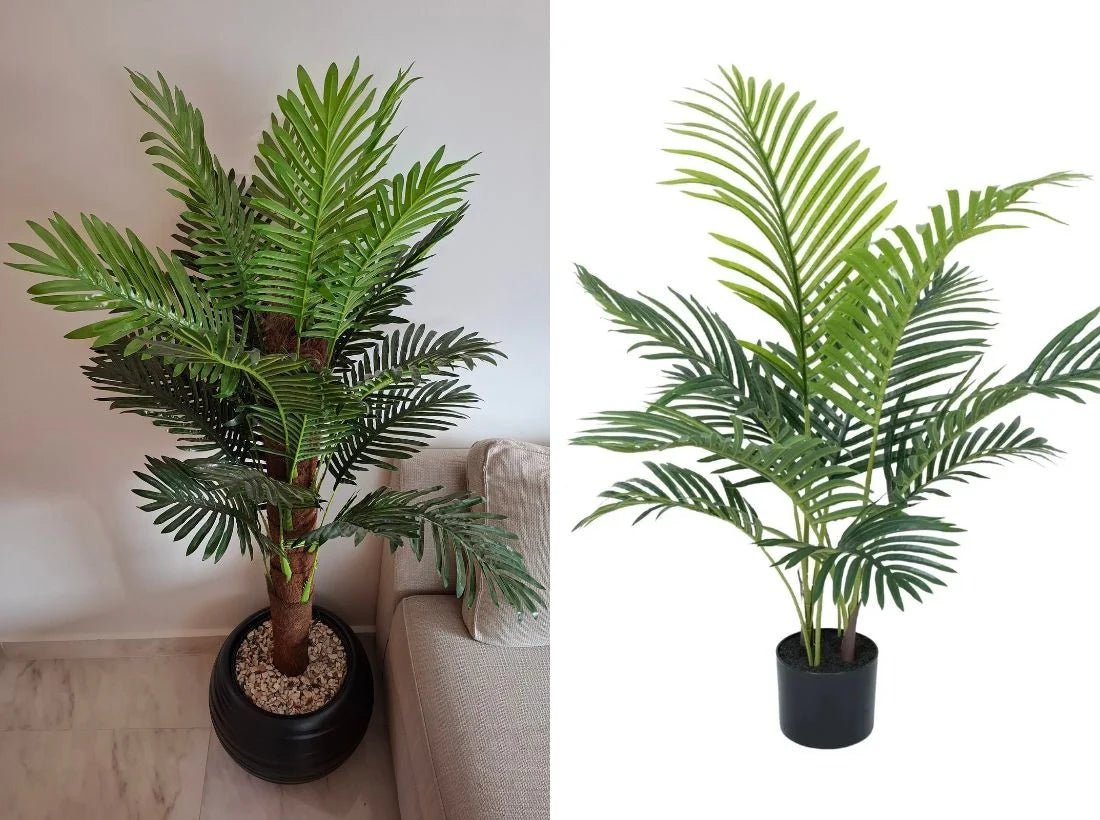
Quick answer: 5 tells give away a fake tree: a smooth, tube-like trunk, evenly spaced branches, identical leaves, a bare foam or glued pot top, and proportions that don’t match the real species. Check each one up close or in zoomed photos. A convincing artificial tree shows bark texture and taper, irregular branching, leaf-by-leaf color variation, a dressed pot surface, and believable scale.
You found a faux tree online. The photos look great: a full canopy, a rich green, a trunk that could pass for the real thing. You hover over “add to cart,” and then you hesitate. Will it look like that when it arrives?
That hesitation is more than valid. Photos flatter almost every faux tree. Lighting, angles, and editing hide the details that separate a tree you’ll love for years from one you’ll want to move into a corner within a week.
Two trees can look identical on a screen and look nothing alike in your living room or lobby. Plenty of fake trees look great, but they’re not all great, and a product page rarely tells you which is which.
Thanks to our 2+ decades of experience, our team can usually tell in seconds. Our buyers and installers inspect every tree the same way, and you can run the same checks yourself (even virtually in some cases).
5 tells separate a convincing artificial tree from an obvious fake: the trunk, the branching, the leaves, the pot top, and the scale.
Here are the checks we run, and how you can run them before you buy.
5 Tells That Give Away a Fake Tree
It’s not every day you can learn insider information for pinpointing quality without coming into our showroom or speaking to our team face-to-face.
But since we don’t want you to make a mistake when buying your artificial tree for multiple reasons, we’ve decided to condense what we’ve learned over our 20+ years of operation within the industry and lay it out here.
Here are our top 5 tells that an artificial tree is not of great quality.
Tell 1: The trunk looks obviously plastic
A real trunk tapers. It’s thicker at the base, slimmer toward the canopy, and it carries bark texture, small knots, and color shifts. A badly-made fake trunk often looks like a smooth tube of one diameter, with a glossy finish and a molding seam running down one side.
Of course, since most artificial trees are made of plastic, you can’t expect them to look identical to the real thing, but they should be difficult to pick out from a slight distance. Plus, not all plastic is equal, as some types are higher quality, look much more realistic, and hold up much longer against varying conditions. That’s why we only use LDPE.


How to check:
-
Zoom in on the bottom third of the trunk in product photos. Look for bark texture you can see that doesn’t look like painted color.
-
Look for a seam line or a uniform diameter from base to top.
-
Check where the trunk meets the pot. Real trunks flare slightly at the root. Fake ones often drop straight in like a pole.
The trunk matters most on species where it is the feature. Our Olive Artificial Tree relies on trunk character, and so does the Potted Bamboo with Natural Trunk.
Tell 2: The branching is too even
Real trees branch irregularly. Limbs vary in length and angle, some cross, and gaps open up where light would reach the inside of the canopy. As with all of nature’s creations, trees aren’t perfect, and they shouldn’t be.
Yet, cheap manufacturers often try to “fix” these imperfections and thus make their faux plants look perfect, partly because they think that’s what customers want. And with that, many low-quality fake trees often repeat one branch shape at regular intervals, like a bottle brush.

While from a distance this might not be too obvious, if you look at it for a little longer, it seems almost uncanny. And uncanny makes people scrunch their noses.
How to check:
-
Squint at the silhouette. If it looks stamped from one template, it probably was.
-
Count identical branches. Repetition is the giveaway for low quality.
-
Check the joins on taller trees, which often arrive in sections. A visible step or gap between sections breaks the illusion quickly.
-
Look for varied stem and branch thickness within the same tree.
A good tree also looks right from the side and back, not only from the front. Walk around it, or ask for photos from every angle.
Tell 3: Every leaf is the same
This is the tell you probably already know. Real foliage never matches leaf to leaf. New growth runs lighter, older leaves run darker, and surface texture, veining, and size all shift across the canopy.

Cheap artificial plants use one flat green with a shiny, plastic-like surface that bounces light unnaturally.
That’s why we build our range with RealTex technology, which gives each leaf its own color variation and accurate texture. You can read more about the approach on our page on what makes the Designer Plants difference.
How to check:
-
Look at the tree in daylight, not under shop lighting, and tilt a leaf to see how much it shines.
-
Look for visible glue, uneven spacing between leaves and stems, and stems that feel rigid or brittle.
-
If possible, smell it. A strong plastic odor can point to poor materials, which is one of the signs we cover in our guide to high vs low-quality artificial plants. If you have kids or pets at home, our explainer on whether artificial plants are toxic covers what to ask about materials.
Tell 4: The pot top gives it away

Almost everyone overlooks this one. The eye drops to the base of a tree within a second or two, and a bare foam disc, exposed plastic, or glue-spotted moss ends the illusion fast. Real trees grow out of soil, mulch, or stones, and the surface around the trunk looks lived-in.
How to check:
-
Look for a gap between the trunk and the pot edge.
-
Check the pot against the tree. An undersized pot makes a tall canopy look like it’s about to tip. On our floor-standing trees, we use weighted pot bases for stability, so ask any supplier what holds theirs upright.
If you plan to move a tree into your own planter, dress the top properly. Our walkthrough on how to pot artificial plants shows how to finish the surface so it reads as real.
Tell 5: The scale is wrong
Scale errors are subtle, and our installers catch them first, but now you can, too. If the leaves look too big or too small for the species, if a tall tree carries a thin canopy, or if the pot looks too small for the height, you’ll find that a tree that’s meant to feel grand ends up tall, narrow, and lollipop-shaped.
If you’re looking for products to fit a luxury space, this is a no-go.
How to check:
-
Compare the proportions with the real species. Think about how a real areca palm or olive fills out at that height and compare it with the artificial variation.
-
Read the product page for exact height, canopy spread and pot dimensions, and confirm whether the listed height includes the pot.
-
Tape the height and canopy width on your wall at home before you order to visualize the scale of the tree in your space.
Note that tall faux trees reward extra care. If you’re sizing an outdoor space or a grand double-height entrance, browse our giant artificial palm trees, or see how tall palms sit in a real space in our luxury home tropical palm project.
Unsure what height suits your space? Book a free consultation and send us your ceiling height and floor plan. We’ll recommend a size that looks right.
Your Pre-Purchase Artificial Plant Inspection Checklist
Use this quick list when you shop for artificial plants in person or compare photos online.
|
Check |
What good looks like |
Red flag |
|
Trunk |
Taper, visible bark texture, root flare |
Smooth tube, molding seam, even diameter |
|
Branching |
Irregular lengths and angles, natural gaps |
Identical branches at regular intervals |
|
Leaves |
Color, size, and texture vary leaf to leaf |
One flat green, glossy sheen, visible glue |
|
Pot top |
Dressed surface, tight fit around the trunk |
Bare foam disc, gaps, glued moss |
|
Scale |
Leaf, canopy and pot match the real species |
Oversized leaves, thin canopy, undersized pot |
What to ask a supplier before you buy
We can wax poetic about appearances, but we have to admit that looks only tell half the story. A tree can pass every visual check and still fade in 6 months on a sunny patio (especially in the South, ask us how we know).
To make sure you get the best possible product for your investment, ask your chosen supplier these questions before you order:
-
Is the artificial tree UV-tested for outdoor use? Check the product page for the UV-resistant label, or browse our outdoor UV-resistant range. Our UV-certified trees carry a 5-year warranty against fade and material degradation, and you can read the full terms on our warranty page.
-
Is it fire-rated for commercial spaces? Restaurants, hotels, and offices often need fire resistance as a prerequisite from building inspectors. Our FireTex page explains our NFPA 701 evidence and how we ensure our products are tested against fire safety rules.
-
What materials went into it, and what testing backs the claims? A supplier who has tested will tell you. One who hasn’t will dodge or come through with unsubstantiated claims.
Finishing Thoughts
Telling the difference between a good artificial tree and a wannabe-good one can be much harder than you think, especially if you don’t know what to look for.
We hope these 5 tells will help you separate apples from oranges, just like they’ve helped our team of stylists and installers find the right products to offer and work with. If you’re still in a rut and need some help with your choice, reach out to our team.
We’re happy to answer any questions, no strings attached.
FAQs
-
Can you tell a good artificial tree from a few feet away?
-
Premium artificial trees should be hard to distinguish from live trees at normal viewing distances. Up close, the trunk, pot top, and leaf variation still tell the story, which is why we check them first. So yes, you can tell a good artificial tree from a few feet away, but it’s always best to get up close and check the details.
-
Does a higher price mean a more realistic artificial tree?
-
Often, yes. Cheaper plants usually skip steps like testing and certification, and that shows up in realism and durability. If a faux tree has a suspiciously low price, there’s probably a reason for it, which you might not see until later on. Of course, price alone doesn’t guarantee quality, so we recommend running the 5 checks we do before buying.
-
What if I can’t see the tree before I buy?
-
If you can’t get a live look at the artificial tree, you should zero in on the close-up photos that are likely on the product pages of an online store. If you don’t see any, it never hurts to ask the supplier for close-up photos of the trunk, branches, and pot top. If you’d like to view our range, you can visit our Florida warehouse showroom in Medley or our California warehouse showroom in Temecula (warehouse visits are by appointment).