
Privacy is one of those things you don't notice until it's gone. One day your backyard is your own little world. The next, a neighbor's new second story or balcony looks straight down onto your patio, and every coffee, barbecue, and swim now has an audience.
Here, we'll walk through why that happens, why a bigger fence often isn't the answer, and how an expandable faux privacy fence or artificial ivy privacy fence can fix it fast. You'll also see how our clients solved the same problem, what's built into our screens, and how to install one yourself or with a pro.
Let’s get into it.
The Problem: When a Neighbor Can See Straight Into Your Yard
Overlook usually sneaks up on you:
-
The house next door adds a second story
-
A townhouse goes up behind your lot
-
A neighbor builds a raised deck
Your fence hasn't changed, but now a window or balcony is sitting above it, and your yard feels exposed.
The natural reaction is to build higher. But that road has its own problems:
-
Local rules and HOAs often cap how tall a backyard fence can be, so even a brand-new fence may not clear an upstairs window.
-
A rebuild means quotes, permits, and weeks of work.
-
A living hedge or climbing ivy takes years to fill in, and then needs watering and trimming forever.
-
If you rent, you probably can't touch the fence at all.
What you really need is to block one sightline, and that’s a much smaller job than replacing a fence.
Expandable Faux Privacy Fence vs. a New Fence: Which Gives You Privacy Faster?
A fence keeps people out. A screen stops people from seeing in. When the problem is a window or a balcony looking down on you, it's the second job you care about.
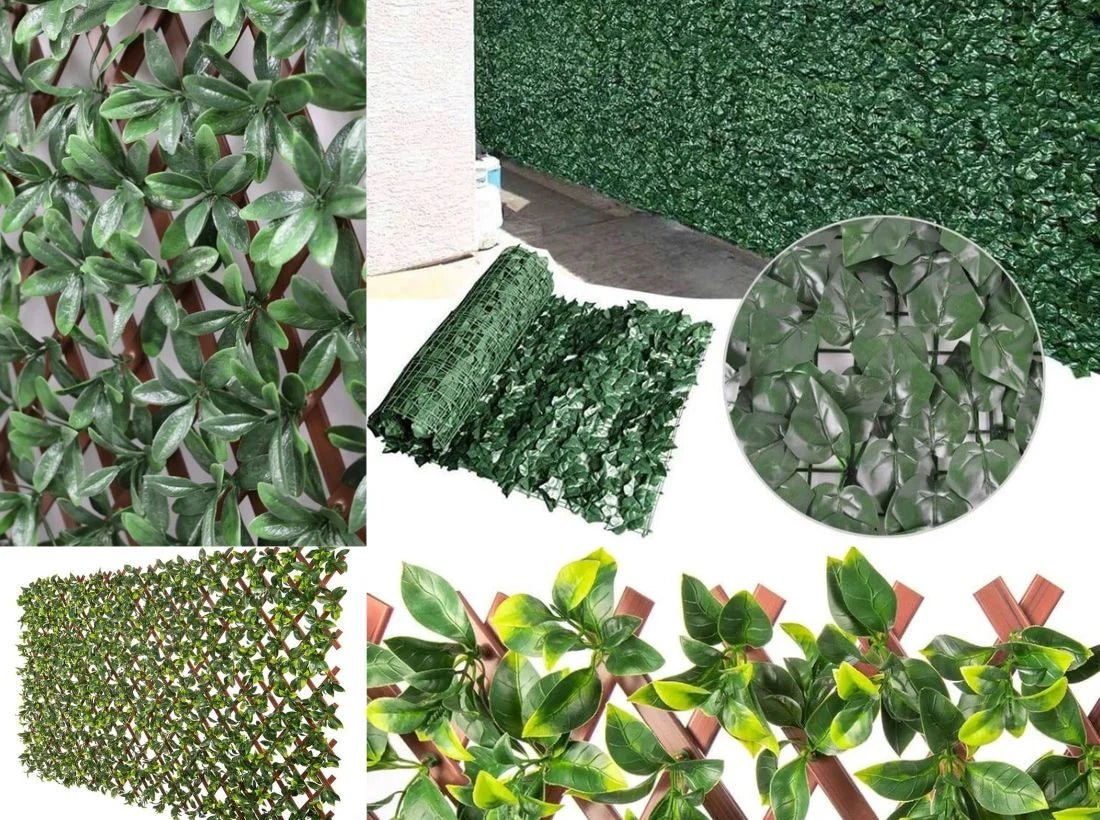
An expandable trellis is a diamond-shaped lattice covered in faux foliage. It folds up small for shipping, then opens up to fit your gap.

An ivy roll is a flexible sheet of faux ivy that you unroll along a fence or railing.
Both fix onto something you already have, so there's no digging, no posts, and no waiting for anything to grow.
To be fair, there are things they can't do. They aren't freestanding, they aren't a security barrier, and they don't count as a pool fence.
We’ve talked about what an expandable faux privacy fence is and when it’s the right choice, but if the goal is "stop people from looking at my patio," a screen gets you there faster and for a lot less than a rebuild.
Who Uses Artificial Ivy Privacy Fences and Trellis Screens?
-
Homeowners and renters. People overlooked by a new build next door, condo owners whose balcony faces another balcony, and renters who can't change the fence. Screens cable-tie on and come off without damage, though it's worth checking your lease first.
-
Businesses. Café and restaurant patios facing a street or parking lot, hotel and resort balconies and cabanas, office rooftops and terraces, and event stylists who want a reusable green backdrop.
In any case, the common thread is that there’s already a structure there, the view is the problem, and nobody wants to wait 3 summers for real ivy to fill in.
How Designer Plants Clients Blocked Neighbor Views
Our team often advises clients on using expandable trellis and ivy fences to block sightlines, but that’s not the only thing that can help you do that. In fact, many of our clients have used other products from our collection to do the same, including (but not limited to) artificial green walls.
Here are just a few projects that benefited from artificial greenery:
Extending a pool fence

One homeowner's metal pool fence just wasn't tall enough for full privacy.
So, they had installers screw timber posts along it, added beams running above the old fence line, then hung Lush Spring panels from the top down. Even the pool door disappears into the wall.
Screening an exposed side of the pool

For another client, 3 sides of their poolside had glass fencing, but one side felt too open. The team built a treated-timber frame, fixed Dark Boxwood panels to it for extra height, and cut panels to hide the gate. The client wanted to be hands-on, so we planned it together.
See the poolside fence project.
Covering a boundary wall

A new build had a long, bare block wall facing next door in full afternoon sun. White Oasis panels went straight on with galvanized screws and UV-rated cable ties, starting from the most visible end.
Greening a metal fence without drilling

These homeowners wanted their metal fence covered without a single hole in it. Panels went onto wooden battens fixed to the fence, so nothing touches the metal. It's the same trick we use for rentals.
Full-height privacy for a spa courtyard

A plain rendered wall sat behind a luxury hot tub. Jasmine panels went straight onto the masonry in a single day and gave the space full-height privacy.
Read the Laguna Beach case study.
How to Install a Trellis or Artificial Ivy Privacy Fence
Good news: it's mostly cable ties and patience, and our installation guide covers every surface, from timber to brick to chain-link.
Here's what's different about trellis and ivy:
-
Expandable trellis: Don't just pull it open as far as it goes. The more you stretch it, the more open the lattice gets. Keep it a little tighter for denser leaves, and open neighboring screens by about the same amount so they match. Fix it along the top, bottom, and middle, not just the corners, then fluff the leaves.
-
Ivy roll: Work in one direction and keep the backing evenly tight so it doesn't sag. Staples or screws should grab the backing, not the leaves. On mesh or railings, cable-tie through it. Trim with scissors around posts and gates.
Fixings. Use UV zip ties on mesh and railings, and self-drilling screws with washers on metal or board.
DIY or professional installation?
Fixing onto a solid fence or railing at normal height? You can do this yourself in an afternoon.
Call in help if you need a frame built above the fence line, you're on a windy high-rise balcony, or it's a long commercial run. We work with installers in California, Texas, Los Angeles, New York and Miami.
Either way, check HOA and height rules before going above your fence.
Built to Last: The Technology Inside Designer Plants Screens
Fake greenery has a bad reputation, mostly because cheap versions fade and look plastic after one summer. Here's what's different about ours:
-
UVTex: Many screens have UV inhibitor sprayed on the surface, which can fade within 12 to 18 months in direct sun. UVTex builds the inhibitors into the leaf itself, so color holds up far longer.
-
RealTex: Leaf-by-leaf color variation, varied stem thickness, and real texture, so it reads as living foliage from your patio chair.
-
SafeTex: RoHS and REACH compliant, and safe around kids and pets.
-
EcoTex: Free from lead and heavy metals, and eligible for our product recycling program.
-
FrostTex: The trellis and ivy ranges are rated to handle winter as well as summer.
We also have a fire-resistant range, our FireTex range, but most of our trellis and ivy products aren’t fire-rated. If your project needs fire-tested greenery, we can help you choose products tested to NFPA 701 via a free consultation.
Finishing Thoughts
Being overlooked doesn't have to mean a costly rebuild or years of waiting for a hedge.
Most of the time, the fix is a screen at the right height, fixed to something solid. Our clients have done it with panels on timber frames, battens on metal fences and screws straight into masonry, and the same thinking works with an expandable trellis or ivy roll.
Browse the expandable trellis range or the full trellis and ivy collection. And if you’re not sure what suits your space, send us a photo and measurements for a free consultation, or book a visit to our Medley, FL, or Temecula, CA showroom.
FAQs
-
Can an expandable faux privacy fence replace a real fence?
-
No. An expandable faux privacy fence attaches to an existing fence, railing, wall, or frame. It isn't freestanding, and it isn't a security or pool barrier.
-
Can I use trellis or ivy on a rental balcony?
-
Usually, yes, you can use trellis or ivy rolls on a rental balcony, but we still advise you to speak to your landlord or property owner. Cable ties come off cleanly without damaging the railing, but you should check your lease and building rules first, as we can’t give advice on matters outside our expertise.
-
How do I keep trellis or ivy secure in the wind?
-
Fix your panel or lattice at plenty of points, use UV-rated ties or screws, brace any wobbly fence, and check the fixings each season.