
Most of the guidance out there on fire-resistant artificial plants is written for commercial specifiers. Building managers. Architects. People navigating NFPA 701 compliance for a hotel lobby or a retail fit-out.
Nobody writes it for the homeowner who wants a green wall behind their outdoor kitchen, or the person who just moved into an apartment and wants trailing plants above the gas range, and who has no idea whether that's a reasonable thing to do or a bad idea.
We get these questions constantly, and this is our answer to all of them for you.
Let’s get into it.
What Does "Fire-Resistant" Mean for Fake Plants?
Fire-resistantdoes not mean fireproof. No artificial plant, including our FireTex range, is fireproof. In fact, there is no one material that is 100% fireproof.
However, there are many materials, including some artificial plants, that are fire resistant or fire retardant.
Fire-resistant means that the material has been tested under a standardized procedure and shown to self-extinguish when the ignition source is removed, rather than continuing to burn and propagate flame.
For our fire-resistant artificial plants, this works via FireTex. FireTex integrates fire-retardant compounds directly at the polymer level. It's not a spray coating applied after manufacturing; it's part of the material structure itself. When a FireTex panel is exposed to a controlled flame and the flame source is removed, the material self-extinguishes.
For the US, our range is NFPA 701 certified and has been tested by third parties to ensure safety and spread.
Of course, having fire-resistant faux greenery doesn’t mean that it’s safe to place your decor directly adjacent to an open flame, a fire pit, or a heat source. These features don’t eliminate the fire risk completely, they just don’t propage the flames once they already reach the plant.
How to Handle Artificial Plants in the Vicinity of Heat Sources
If you’re planning to install artificial green wall panels or set up faux hanging plants in an area with a heat source, there are a few things you need to consider.
Since many of our clients are commercial properties, we’ve had this discussion more than a few times, to say the least.
Here are some tips you need to know about the most common heat sources and how to keep your environment safe:
Patio heaters

Freestanding or wall-mounted patio heaters are the most common heat source people ask us about, and the most manageable, because the heat they produce is radiant and directional, not open flame.
The relevant question here is how far away from the heater is your artificial plant?
Standard electric and gas patio heaters produce intense radiant heat directly below and immediately around the heating element. The thermal effect drops off significantly with distance.
A plant placed 3 feet or more from the heat cone of a patio heater receives ambient warmth rather than intense radiant heat, and standard artificial products perform fine at that distance.
The zone of concern is anything within 18–24 inches of the heat output, directly in line with the element.
We don't recommend any artificial greenery in that zone regardless of fire rating because sustained radiant heat at close range will degrade any LDPE material over time even without reaching ignition temperature.
Practical guidance:
-
Keep greenery at least 2–3 feet from the heat cone of a wall-mounted or freestanding patio heater
-
If the heater is directly below an overhead garland installation, FireTex NFPA 701-rated hanging plants are the right specification for that ceiling position
-
Never position any artificial plant directly above an upward-facing heating element
Outdoor fire pits

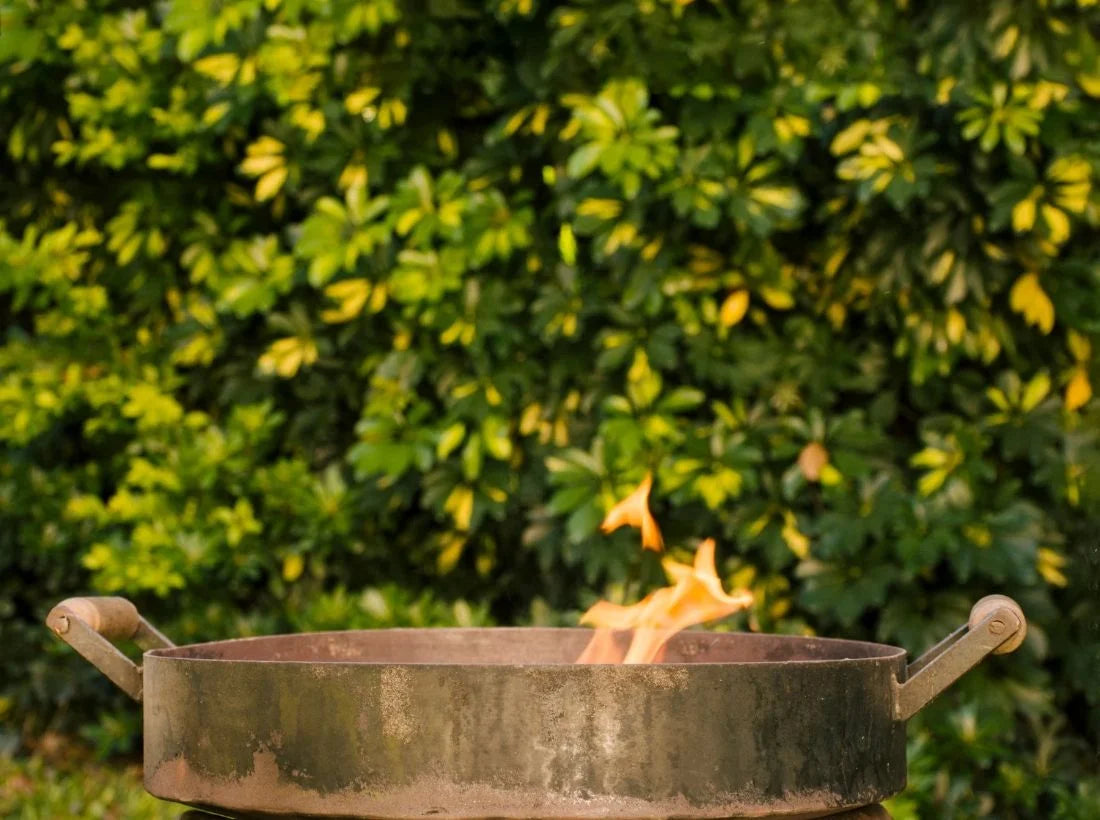
A fire pit produces open flame, embers, and radiant heat in multiple directions simultaneously. No artificial plant belongs in close proximity to an active fire pit, fire-resistant or otherwise.
That said, fire pits are often the centrepiece of outdoor entertaining areas that people want to make beautiful. And there’s still a way to do that. The answer is distance and product selection.
Artificial greenery on the perimeter of a fire pit area, like a panel run on a boundary fence 6–8 feet from the pit or a potted plant at the edge of the seating zone, is entirely reasonable, and for that application FireTex product is the sensible choice.
Practical guidance:
-
Maintain a minimum 6-foot clearance between any artificial greenery and an active fire pit
-
For boundary and perimeter greenery in fire pit entertaining areas, specify FireTex fire-rated panels
-
Never drape or position artificial garlands overhead in a space where embers could reach them
-
When the fire pit is not in use, standard non-fire-rated product is fine at the same distances
Outdoor BBQs and kitchen areas

An outdoor kitchen or BBQ area is where most of the practical questions arise.
A vertical garden wall behind an outdoor kitchen is one of the most photographed installations in our residential portfolio. It looks spectacular and it works because it's installed on the wall behind and above the cooking surface. It’s not directly above the grill grates, not adjacent to the burners, and not within the grease splash zone.
The heat a BBQ or outdoor kitchen produces is directional upward from the cooking surface. A panel installed on the wall at the back of the outdoor kitchen, above a range hood or splashback, receives exhaust heat rather than direct flame and gets completely different exposure.
Practical guidance:
-
Keep panels at least 12–18 inches above any exhaust point from the cooking surface
-
For any position closer than 24 inches vertically above cooking equipment, use FireTex NFPA 701-rated panels
-
Clean grease accumulation from any adjacent surfaces regularly because it can increase ignition risk
-
If the BBQ has a hood, that changes the heat distribution significantly, as panels above a hooded grill are in a different heat environment than panels above an open grill
Indoor kitchen backsplashes

Artificial plants on or adjacent to an indoor kitchen backsplash are in a different risk category from outdoor entertaining areas. A gas range or electric cooktop in an enclosed indoor kitchen produces a much more concentrated heat and grease environment than an outdoor BBQ.
Cooking fires are a real household risk, and any combustible material near a cooktop or gas range adds fuel.
For this reason, we don't recommend any artificial plant installation in close proximity to an indoor kitchen cooktop or range, at all. The self-extinguishing property of FireTex is still relevant for accidental ember contact in a larger space, but it doesn't change the risk profile of materials directly adjacent to a domestic gas flame or electrical heating element.
What we can support: greenery installed away from cooking zones in an open-plan kitchen. For example, we can install panels above cabinets on the far side of the room, on an island pendant structure above a dining zone, or on a wall feature away from the cooking surface.
The kitchen in those applications is the backdrop, and the greenery is in a low-heat, low-grease zone.
If you're set on greenery in the cooking zone itself, please contact a relevant authority to understand what you can or can’t do.
The Right Product for Each Heat-Adjacent Scenario
For any scenario where there's proximity to heat, FireTex NFPA 701-certified products are the specification we recommend because the self-extinguishing polymer provides a meaningful additional safety margin compared to standard LDPE if ignition occurs.

For outdoor patio heater zones: Fire-rated hanging garlands if overhead positioning is required.

For fire pit perimeter areas: FireTex NFPA 701-rated green wall panels on boundary walls and fencing around the entertaining area.

For outdoor BBQ and kitchen walls: FireTex panels for the wall above and behind cooking equipment, with a proper splashback maintaining separation between the cooking surface and the greenery.

For indoor spaces away from cooking zones: Standard non-fire-rated products are appropriate for spaces with no significant heat source proximity. Our Dense Lush Boxwood and Floral Fusion are the most frequently specified panels for kitchen-adjacent interior feature walls.
Finishing Thoughts
The honest answer to "can I put fake plants near my fire pit / BBQ / patio heater" is: it depends on the distance, the heat source, and whether you're using the right product for the application.
It's not a blanket yes and it's not a blanket no.
What we can tell you with confidence: distance matters more than fire rating at the extreme ends of the heat scale, and for scenarios where proximity to heat is unavoidable, FireTex-rated products are always the right choice over standard LDPE. The self-extinguishing polymer is a real safety advantage and not just a substitute for sensible placement decisions.
If you're planning an outdoor kitchen, a fire pit entertaining area, or any heat-adjacent greenery installation and want a second opinion on the specific layout, our team looks at this kind of thing regularly, so we implore you to reach out to our experts via a free consultation.
During a free consultation, our team assesses your space virtually, answers all your questions, and provides recommendations for products and placements that would work best. It’s 100% free and no strings attached.
FAQs
-
Can I put artificial plants near a patio heater?
-
Yes, with appropriate distance. Keep greenery at least 3 feet from the heat cone of any patio heater. For positions directly overhead or within 3 feet, use FireTex NFPA 701-rated products and maintain that clearance. Keep all products away from open flames or direct heat contact.
-
Are fire-resistant artificial plants safe near a fire pit?
-
Fire-resistant means the material self-extinguishes when an ignition source is removed, but it does not mean the product is safe for use adjacent to an active open flame. Maintain a minimum 6-foot clearance between any artificial greenery and an active fire pit. FireTex-rated products are the right specification for perimeter greenery in fire pit areas, where ember and spark exposure is the relevant risk.
-
Can I use fake plants as a kitchen backsplash?
-
We don't recommend artificial plants in close proximity to an indoor cooktop or gas range. The risk profile of materials directly adjacent to a domestic cooking flame or heating element is different from the ember-and-spark exposure that FireTex addresses. For kitchen-adjacent greenery, install it well away from the cooking zone.
-
What is FireTex and how is it different from standard artificial plants?
-
FireTex integrates fire-retardant compounds at the polymer level during manufacturing, so it's not a surface coating that degrades. When exposed to a flame source that is then removed, FireTex material self-extinguishes rather than continuing to burn. Products described as fire-resistant or flame-retardant are not fireproof, and should be kept away from open flames, heaters, and ignition sources.
-
Do I need NFPA 701 certified plants for my home?
-
NFPA 701 certification is primarily a commercial building code requirement. For residential use, it's not mandated, but FireTex-rated products provide a meaningful safety advantage in any scenario with proximity to heat sources, whether or not compliance is legally required. For commercial use, it’s more than likely that you’ll need some sort of certification.
-
Where can I find fire-rated artificial plants?
-
Browse our full FireTex fire-rated collection, which includes both panels and hanging plants with NFPA 701 certification and independent lab test reports available on request.