
Do artificial plants fade outside?
It depends. The most honest thing we can tell you about outdoor artificial plants and fading is this: most of the advice you'll find online treats all artificial plants as the same product with the same problem and the same solution. But they’re not.
Whether your outdoor artificial plants fade (and how fast) depends almost entirely on one decision you made before you bought them: whether the UV protection is built into the material itself, or whether it exists only as a surface coating.
Everything else is either maintenance or damage control.
This guide covers both. We'll explain the material difference that matters most, when UV spray actually helps, when it doesn't, and what to do in every outdoor scenario.
Let’s get into it.
Why Outdoor Artificial Plants Fade
UV radiation from the sun breaks down pigments in plastics. This means that every colored synthetic material, like LDPE, polyester, nylon, and silk, is vulnerable to this process. The sun's UV rays disrupt the chemical bonds in dyes and pigments, causing them to bleach progressively.
In parts of the US with intense sun (like here in Florida), this process is significantly faster than in northern states with a lower annual UV index.

The result is what most people recognize and fear: foliage that's still structurally intact but looks washed out, dull, or bluish-green rather than the rich green it was on installation day.
The faux plant won’t die, but it’ll look like it did.
The speed at which this happens depends on the product's UV resistance, specifically, whether that resistance is integrated into the material or applied to the surface.
Integrated vs. Surface-Applied UV Protection
There are 2 types of UV protection for artificial plants: integrated (in-leaf) and surface-applied (sprayed-on). Here’s what each one means:
-
Integrated UV inhibitors: In this approach, UV Inhibitors are bonded within the polymer material during the manufacturing process. The advantage here is that the protection doesn’t degrade because it’s part of the material itself rather than a coating on top of it. In short, this means that they continue to function throughout the product's life. The UV protection in year 5 is the same as in year one.
-
Surface-applied UV treatments: This approach includes coatings, sprays, or dip treatments applied during or after manufacturing. The difference is that they provide UV resistance for a limited period and will likely degrade with UV exposure, rain, cleaning, and temperature cycling. A product with surface-applied UV protection will perform better than one with no protection at all, but the protection diminishes over time, and you’d need to reapply it.
Our UVTex technology works on the first principle: UV inhibitors are integrated within the LDPE leaf material during manufacturing. Every panel, hanging plant, and outdoor product in our UV-rated range carries this protection as a material property. This is what backs our 5-year UV warranty — protection that doesn't degrade the way surface treatments do.
When you're evaluating any outdoor artificial plant, ask the supplier two questions:
-
Is the UV protection integrated within the material, or is it a surface coating?
-
What is the warranty period specifically covering color retention outdoors?
If the answer to the first question is "surface coating" or unclear, and the answer to the second is less than three years for a full-sun application, treat the product as a limited-lifespan outdoor option. It might work great indoors, but it won’t be the best option for outdoor decor.

When UV Spray Helps and When It Doesn't
If you’ve determined that you don’t need integrated UV resistance, our UV Protection Spray is a product we developed in-house and recommend for cases like these. Still, it’s important to have a clear understanding of what it does and doesn't do.
UV spray helps when:
-
You have an existing outdoor artificial plant without integrated UV protection and want to extend its “life”
-
You have a UVTex-rated product in a particularly harsh exposure environment (full sun, coastal reflection off water, desert conditions) and want additional protection
-
You're applying it periodically as part of a maintenance routine to maximize color vibrancy on any outdoor product
UV spray doesn't help:
-
Restore fading that has already occurred and can’t reverse any visible degradation
-
Provide the same level of protection as integrated UVTex inhibitors, and the protection from spray degrades faster than integrated inhibitors
-
Make a non-UV-rated product perform equivalently to a UV-rated one over a multi-year installation
How to apply it correctly: Clean the plant or panel thoroughly before spraying and apply generously and evenly across the entire surface, including the stems and backing. Test on an inconspicuous area first to confirm colorfastness for the specific product. Reapply every few weeks for products in direct full-sun exposure, or every few months for products in partial shade or covered outdoor positions.
Does Your Outdoor Application Need a UV-Rated Product?
It might and it might not, as not every outdoor position is equivalent. We get this question regularly, and the answer is that UV exposure varies significantly by orientation, shade, and geography.
Full UV-rated product is necessary when:
-
The installation is in direct sun for hours per day
-
The installation receives intense afternoon sun
-
The site is in a high-UV geography (Florida, California, the Southwest, coastal areas)
-
The installation is permanent, and you expect it to look identical in 5 years
UV-rated products are strongly recommended but not strictly critical when:
-
The installation is in partial shade, like morning sun, dappled light, or covered areas
-
The installation is on a north-facing wall that receives ambient but not direct light
-
The installation is a short-term seasonal display rather than a permanent feature
UV-rated product may not be necessary when:
-
The installation is fully covered, like under a solid roof or in a fully enclosed patio, with no direct or indirect UV exposure
-
The installation is indoors and not near a window that gets direct sun
When in doubt, we always recommend specifying a UV-rated product. The cost difference between UV-rated and non-UV-rated in our range is modest, and the consequence of under-specifying is an installation that degrades visibly within a few years.
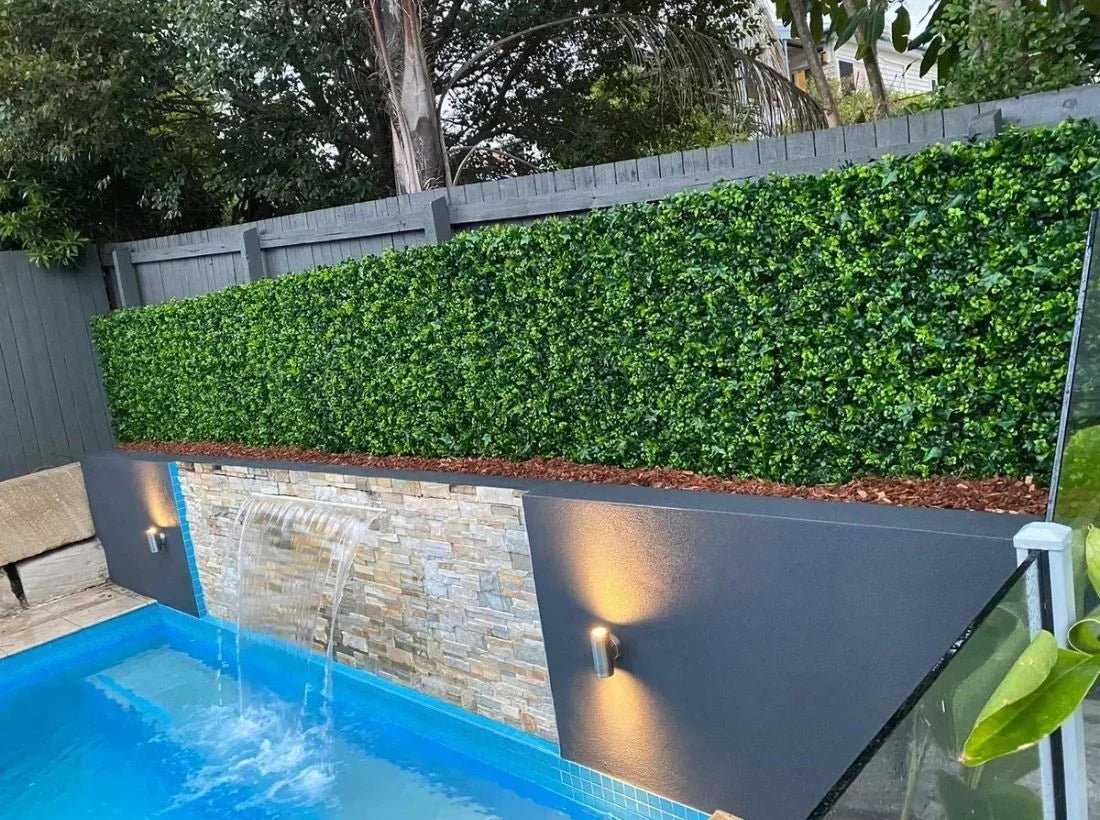
The Mediterranean poolside transformation and the outdoor dining space in our blending guide both used fully UV-rated products for exactly this reason: the exposure conditions in both cases left no room for compromise.
How to Extend Fake Plant Lifespan via Good Placement
For products without integrated UV protection, placement is the highest-leverage variable available. Direct, sustained sun exposure causes the most damage, while partially shaded positions degrade significantly more slowly.
For freestanding plants and potted plants that can be moved, position them where they receive morning sun and afternoon shade wherever possible, because exposure to afternoon sun is the most damaging orientation in most US climates.

For green wall panels and fixed installations, this means thinking carefully about wall orientation before installation. A north-facing wall will hold its color far longer than a south- or west-facing one with the same product.
For covered porch and balcony installations, the overhang provides meaningful protection, even if the plant is technically "outdoors." A covered position substantially reduces UV exposure and extends product life. Check out how you can tackle outdoor rooftop and patio green walls for every common outdoor installation type.
Cleaning Artificial Plants: What It Does and Doesn't Affect
Cleaning doesn't protect against UV fading, but it does prevent the secondary degradation that makes faded plants look worse than they are. Dust, pollen, organic debris, and environmental particulates accumulate on foliage and dull its appearance even before any UV degradation occurs.
Monthly cleaning for outdoor installations is our standard recommendation. For high-traffic outdoor positions or dusty environments, more frequent cleaning is worthwhile.
Use a soft brush or low-pressure hose rinse for routine cleaning. For heavier build-up, a damp cloth with mild dish soap applied gently and rinsed thoroughly is appropriate for LDPE panels. Avoid high-pressure water, which can displace foliage and stress panel fixings.
Our official cleaning guide covers the specific approach for each product type, so check that out before you get your hands dirty.
How to Buy Right the First Time
Buying correctly specified UV product upfront costs less over the lifetime of the installation than replacing incorrectly specified product.
A non-UV-rated panel at a lower price point that fades significantly within 2 years and requires replacement costs more over 5 years than a UVTex-rated panel at a higher price point that holds its color across the same period.
This is not a theoretical argument; it's the practical outcome we see repeated consistently when clients who purchased lower-quality products elsewhere come to us for a replacement.
Choosing a manufacturer who understands UV resistance and makes high quality UV resistance foliage will always save you more in the long run. Before you buy, always ask whether the UV protection is integrated within the material or surface-applied. That single question tells you more about the actual long-term performance of a product than any other detail.
Our UV warranty is the documented commitment behind this position. For outdoor-rated products, we warrant color-fast performance for 5 years under normal outdoor exposure conditions. This is a warranty period we're in a position to offer because UVTex integration means the protection doesn't diminish over time.
Finishing Thoughts
Fading is a real and manageable outdoor artificial plant problem. Luckily, it’s manageable because the primary cause is predictable and the primary solution is available at the point of purchase.
Buy a UVTex-rated product with integrated UV inhibitors for any outdoor installation, apply UV spray in high-exposure environments, clean regularly, and the result is an outdoor greenery installation that holds its shape and color for years without replacement.
The clients whose installations look as good in year 5 made the right product decision at the beginning.
If you're browsing outdoor artificial greenery and want to confirm the right product for your specific orientation and geography, our team is here to help before you order with a free consultation.
FAQs
-
What is UVTex and how is it different from UV-resistant spray?
-
UVTex is Designer Plants' UV inhibitor technology, and it’s integrated within the LDPE leaf material during manufacturing. Unlike spray treatments that degrade with UV exposure and weathering, UVTex inhibitors are part of the material itself and maintain their protective function throughout the product's life. Our UVTex page covers the full technical details.
-
Does UV spray stop artificial plants from fading completely?
-
No. UV spray significantly slows the fading process but doesn't prevent it entirely or reverse existing fading. It's most effective as a supplementary maintenance step for products with integrated UV protection, and as partial protection for products without it.
-
How long do UV-rated outdoor artificial plants last?
-
Our UVTex-rated outdoor products carry a 5-year UV warranty covering color retention under normal outdoor exposure. In practice, well-specified products in moderate exposure conditions often perform considerably beyond the warranty period. The 5 years is the committed minimum.
-
Do I need a UV-rated product for a covered patio or balcony?
-
For positions that receive indirect UV, UV-rated product is strongly recommended in high-UV geographies (Florida, California, Southwest). For fully covered positions with no direct or indirect UV exposure, you might not need to. When in doubt, UV-rated product is the safer specification.
-
Can I apply UV spray to panels to extend their lifespan?
-
Yes. The UV Protection Spray is compatible with panels and is the product we recommend for supplementary protection in high-exposure outdoor environments. Clean the panels thoroughly before applying and reapply often for direct-sun positions.
-
What's the most damaging outdoor position for artificial plants?
-
West-facing direct sun in a high-UV geography, particularly in summer months when afternoon temperatures are highest. Coastal positions with UV reflection off water are similarly demanding. For any of these conditions, a UVTex-integrated product and reapplying UV spray is our recommended approach.