
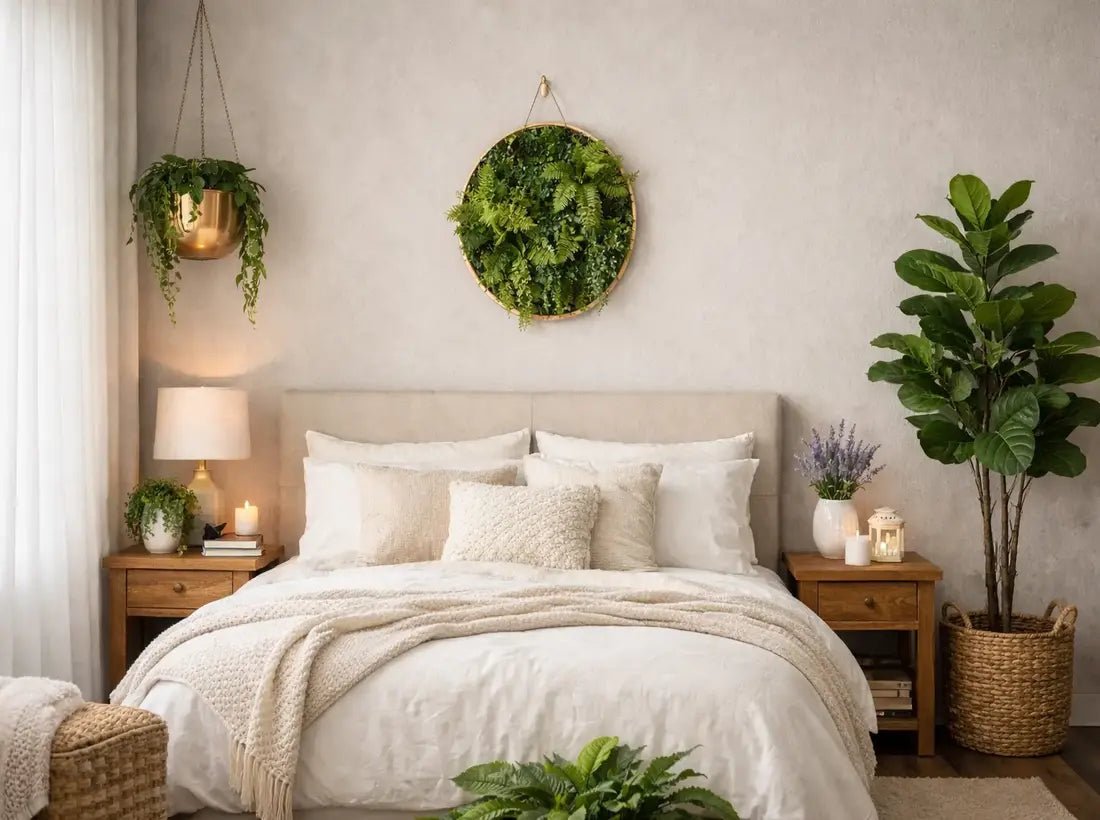
When our expert plant stylists look at photos of a client's space for the first time, they’re not looking at the furniture first. In fact, they’re looking at how the space breathes.
Does it feel alive?
Is there visual softness?
Is there anything anchoring the room to nature?
Unfortunately, more often than not, the answer is no. And that's exactly where artificial plants come in.
Our plant stylists have a varied role: part interior designer, part botanist, part therapist. They love helping clients turn their bedrooms from functional sleeping spaces into sanctuaries and rooms that signal to your nervous system that it's safe to slow down.
The right greenery is one of the most powerful (and underused) tools for doing that. Whether you're working with real plants or opting for premium faux greenery, you’ll need a checklist that walks you through exactly how to approach a bedroom refresh from the ground up.
Keep reading to get the details.
6 Steps to Create a Calming Bedroom Retreat
Thanks to our 20+ years of experience working with artificial greenery and interior decor, we’ve found that the best way to approach a decor project with artificial plants is to use a simple 6-step framework.
Here’s how it goes:
Step 1: Audit the scale before you buy a single plant

The most common mistake we see homeowners make is buying a faux plant they love the look of, only to watch it struggle in a dark corner. Before any greenery enters the room, you need to map the layout and the scale.
Here’s our favorite tip to get this right: Lie down on the bed and look straight ahead. Whatever wall your eye lands on first is your focal point (it can even be the ceiling!), and that’s where the highest-impact greenery should go. Everything else in the room supports that anchor.
Because our artificial green wall panels require no soil, no drainage, and no light source to thrive, they work in any bedroom configuration, including north-facing rooms, windowless dressing areas, walk-in wardrobes, and basement suites.
Step 2: Identify your bedroom's 'plant zones'
Once we see photos of the space from a few different angles, we divide every bedroom into three zones: the focal point wall, the bedside areas, and the transitional space (entryway, dressing corner, or window nook). Each zone has a different visual weight and calls for a different greenery approach.
-
Focal point wall: This is for impact. A large-scale artificial green wall panel behind or beside the bed is one of our signature moves. It creates the same mood as wallpaper but with an organic texture. Try the Luxury Country Fern Vertical Garden for a lush, immersive feel at an accessible price point.
-
Bedside areas: Keep these intimate and proportionate. Trailing plants on bedside tables, like a small hanging pothos or a faux button fern, add softness without visual clutter. Avoid oversized pots here; the eye needs to rest after looking at your panels.
-
Transitional spaces: This is where we’d place something with height or movement, like a palm stem, a draping hanging bougainvillea, or a tall boxwood topiary. It marks the threshold as you enter and sets the tone for the entire room.
Step 3: Choose greenery that supports rest

In a bedroom, the goal is calm. Even though you may like “rich” faux plants, we recommend steering away from spiky, angular, or overly busy foliage patterns and toward lush, rounded leaf shapes that feel soft to the eye.
Our go-to forms for a calming bedroom retreat:
-
Deep, solid greens (ferns, moss walls, Boston ivy) which recede visually and create depth
-
Trailing vines and garlands for movement without weight; the willow leaf garland bushes draped over a shelf or headboard frame is a favorite
-
Soft florals in muted tones, like pale lavender or white blossom adds a spa-like quality; consider the Artificial Purple Lavender Wall Panel for subtle color
Step 4: Use height and layering to create a cocooning effect
One technique we use in almost every bedroom project is what we call the 'cocooning layer.' The idea is to create a sense of enclosure, i.e., faux greenery at high, mid, and low levels that makes the room feel nestled rather than sparse.
For example, you can hang a gold-framed hanging green wall disc from the ceiling above a seating nook or reading corner. Pair it with a floor-level artificial potted monstera tree for grounding energy at the base. This high-low combination is a designer's shortcut to a room that feels curated.
For ceilings under 9 feet, keep hanging elements above eye level so they frame the room. For taller ceilings, draping Boston fern garland bushes from an exposed beam or curtain rod adds stunning depth you rarely see indoors.
Step 5: Style the vessels, pots, and planters

Greenery and its container should tell one visual story. We always advise matching pot materials to the room's existing textures: terracotta for warm rooms; matte black or brushed stone for modern minimalist spaces; woven rattan for coastal or Japandi-style interiors.
If you're using artificial potted plants, many of those in our collection come with starter pots, which are usually simple and black. However, we also carry other, more decorative pots and planters that can improve the appearance of your artificial plants without any “repotting”.
On the other side, garlands are designed to mount directly to a wall or be draped freely, which means the 'vessel' is the architecture of the room itself. This is a stylistic advantage because you won’t be dealing with mismatched pots or plant stands.
Step 6: The allergy-free bedroom design
When we first started the business, we sold only real plants. But, with the increasing number of clients asking us for artificial options due to maintenance concerns, we changed our offering. Then, we started working with clients who had allergies, young children, or pets, and we realized that insisting on real plants was putting my aesthetic preferences above their well-being.
High-quality artificial plants have closed the gap enormously. At Designer Plants, you get faux greenery crafted from ROHS-compliant, toxin-free materials with UV-resistant finishes that maintain color for up to 15 years.
In a bedroom, a space where you spend roughly a third of your life, having zero pollen, zero mold risk from overwatering, and zero maintenance is simply smart design.
Your Bedroom Plant Styling Checklist at a Glance
Map your bedroom's natural light before choosing any greenery
Identify your three plant zones: focal wall, bedside, and transitional space
Choose soft, rounded leaf shapes and muted tones for a restful atmosphere
Layer greenery at high, mid, and low levels for a cocooning effect
Match pot and vessel materials to the room's existing texture palette
Check all artificial greenery options for allergy-sensitive or low-maintenance bedrooms
Don't overcrowd, three to five types of greenery in a bedroom is enough
Finishing Thoughts
If you're starting your bedroom project and want to explore premium faux greenery options, browse the full collection to see all the stunning products you can work with.
If you want bespoke advice or need more information, our team of expert plant stylists also offers a free design consultation with tips on scale, placement, and product selection for your specific space.
We’ve got so many ideas for creative bedroom projects, so don’t wait up - let’s work together.