
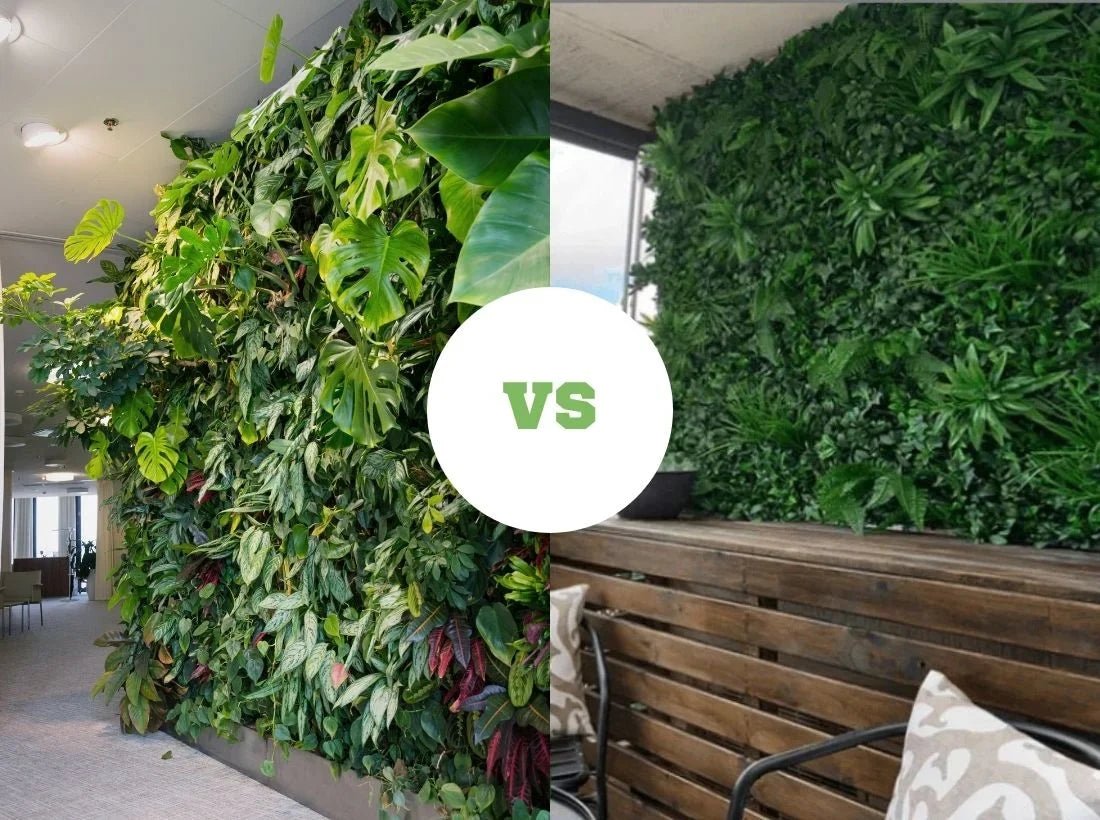
Greenery changes a space. It softens hard architecture, adds color where there'd otherwise be a blank wall, and makes a space look finished. But the moment you start planning a green wall, you hit a fork in the road: do you grow it, or do you install it?
A few years ago, that question had an obvious "correct" answer: real plants, because they're real. That thinking has shifted. Advances in UV-stabilized materials, denser foliage construction and fire-rated backings mean artificial green walls now hold up to scrutiny that fake plants couldn't survive a decade ago.
At the same time, water restrictions, rising maintenance labor costs, and the unpredictability of keeping a living wall alive have pushed more architects, retailers, and homeowners toward artificial systems.
Why is that? Let’s get into it.
Why Artificial Green Walls Keep Gaining Ground
Living walls are beautiful when they're thriving, but "when they're thriving" is doing a lot of work in that sentence.
Irrigation systems fail. Root zones get too hot behind glass or render. Species that look lush struggle in a west-facing courtyard.
None of this is a knock on real plants; it's just the reality of asking a living organism to perform as a permanent design feature in conditions it didn't evolve for.
Artificial green walls sidestep that risk, allowing you to get:
-
Consistent, year-round color and density
-
Freedom from irrigation infrastructure
-
Total design flexibility, as panels can go in low-light lobbies, west-facing walls with no shade, and interior fit-outs with no access to soil or sunlight
-
Predictable long-term cost, with ongoing spend close to zero
Real vs Artificial Green Walls: The Facts
Here's how the two options compare once you look past the initial assumptions and account for the full lifecycle of each system.
|
Factor |
Living Green Wall |
Artificial Green Wall |
|
Upfront cost |
Lower per plant, but requires substrate, irrigation lines, drainage, and often a felt or hydroponic backing system |
Higher per panel, but there is no substrate or irrigation to add |
|
5-year running cost |
Ongoing for water, fertilizer, pruning labor, plant replacement for dieback |
Near zero, with occasional cleaning and, for outdoor panels, a UV protection top-up |
|
Weekly maintenance |
1–3 hours depending on size and species (watering, pruning, pest checks) |
Minutes per month, just occasional dusting or a rinse |
|
Lifespan |
Indefinite if the system is maintained correctly, but individual plants fail and need replacing |
5+ years for UV-certified panels before any fading is noticeable, per current testing |
|
Allergy & pest risk |
Pollen, mold in damp irrigation systems, and pests are all possible |
None: no pollen, no pests, nothing for insects to nest in |
|
Performance in low light / no irrigation |
Requires supplemental lighting or won't survive |
Unaffected, panels look identical regardless of light or water |
|
Fire compliance |
Not typically fire-rated as a system |
Fire-tested ranges available with documentation for commercial specification |
|
End-of-life |
Biodegradable, but irrigation hardware and dead plant replacement adds waste over time |
Recyclable panels through a dedicated take-back program |
The upfront number tells you almost nothing on its own. The maintenance and replacement columns decide which option costs less over the life of the installation.
What Separates a Good Faux Green Wall From a Bad One
Not all artificial green walls are built the same, and this is where most of the horror stories come from. The difference almost always comes down to how the UV protection and structural backing were built in from the start.
At Designer Plants, every panel is engineered around 5 core technologies:

-
RealTex: leaf-level color variation that avoids the flat, uniform "toy plant" look.

-
UVTex: UV inhibitors bonded within the leaf material during manufacturing, which ensures the panels hold their color for years.

-
FireTex: built for commercial and multi-residential projects where compliance documentation is non-negotiable.

-
SafeTex: RoHS and REACH compliant, with test reports available on request, so it’s safe around children and pets.

-
EcoTex: no water, no fertilizer, and no replanting across the life of the product, with a dedicated recycling program across the US.
Why Choose Designer Plants
Every panel is made from UV-tested, ROHS-compliant synthetic material, free of the harmful toxins and chemicals lower-grade imports use, and our fire-tested ranges come with the documentation commercial projects need.


Our panels are modular and fully customizable, which is why architects, developers, builders and certifiers specify them project after project. If you'd like a dense, quick option for a fence line or balcony, the Country Fern is a popular starting point, and for a smaller feature spot, the Artificial Green Wall Disc works well without needing a full panel run.


Every order ships with the option of professional installation support if you'd rather not DIY it. Get in touch with our friendly team for a free consultation to talk through your project, or book a warehouse showroom visit if you live near Medley, FL or Tamecula, CA.
FAQs
-
Is an artificial green wall cheaper than a real one long-term?
-
In almost every case, yes, once you account for irrigation, plant replacement and ongoing labor. The panel itself may cost more upfront, but a quality UV-certified panel needs close to no ongoing spend for 5+ years, while a living wall has recurring water, feed, and replacement costs for as long as it's installed.
-
Do artificial green walls fade in direct sun?
-
Cheap, untreated panels do, and often within one to two months. Panels with UV protection bonded into the leaf during manufacturing, rather than sprayed on afterwards, are built to resist fading for years in full sun.
-
Can artificial green walls be used indoors and outdoors?
-
Yes, but the panel needs to match the environment. Indoor-only panels aren't built for UV or weather exposure, so outdoor and courtyard installations should always use a UV-certified outdoor range.
-
Are fake green walls safe for children, pets and allergy sufferers?
-
Yes. There's no pollen, no soil, no pesticides and nothing for pests to nest in, which is why they're widely used in childcare centers, aged care and hospitality settings.
-
How do you clean an artificial green wall?
-
An occasional dust-down or light rinse is usually enough. For panels that need a deeper clean, a purpose-made cleaner formulated for artificial foliage avoids the residue or discoloration harsher cleaning products can leave behind.
-
Are artificial green walls recyclable?
-
Yes, Designer Plants panels can be returned through our dedicated artificial greenery recycling program at end of life, so they don’t go to a landfill.