
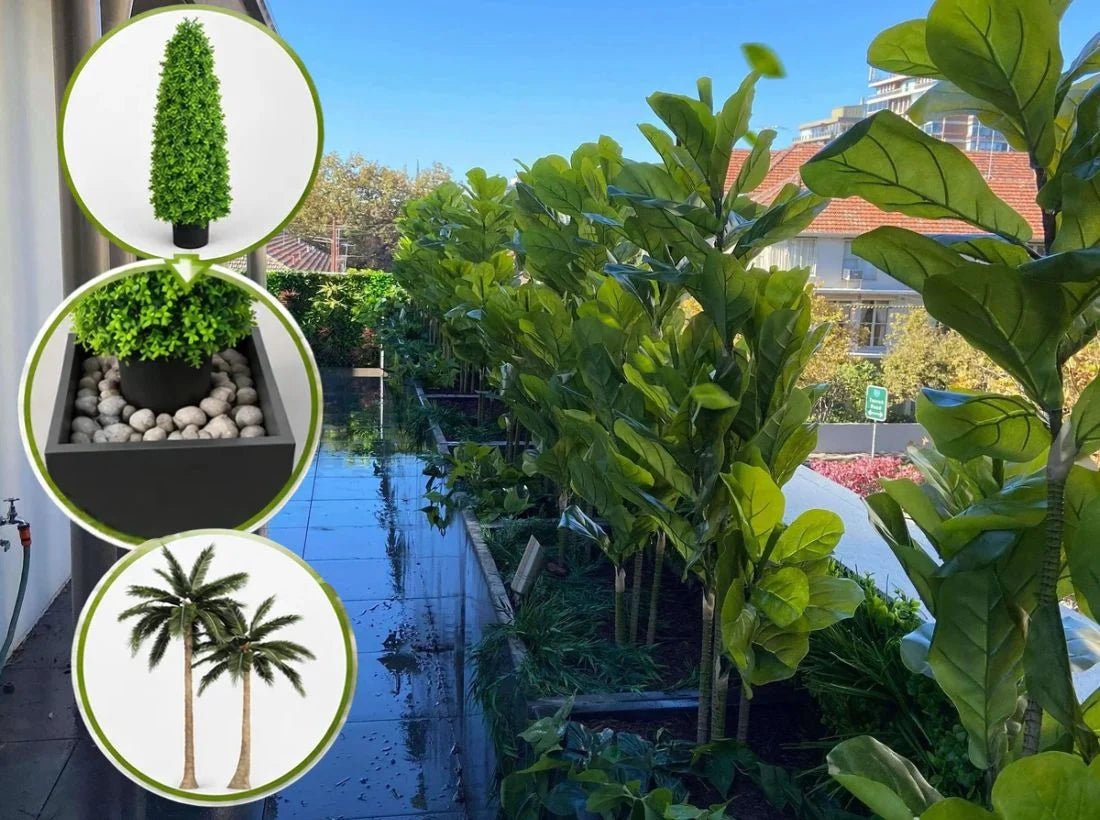
Quick answer: To keep artificial trees upright outdoors, put weight low in the planter, use a wide base, and fix tall or exposed trees to a solid point. Weighted planters suit most patios, in-ground sleeves suit permanent gardens, and bolted bases or tie-backs suit windy rooftops and tall palms.
Love the look of artificial trees on a patio, by an entrance, or around a pool?
There's one thing worth thinking about before you put them outside: wind. Because artificial trees are lightweight by design for easy handling, a strong gust can catch a full canopy and put the whole tree off balance.
Of course, you don’t want to keep adding makeshift weights or awkward supports to a tree you’ve chosen to improve your space.
So, the solution starts with understanding how to give your tree a stable foundation. We’ve supplied commercial and residential greenery since 2005, and tipping is one of the most preventable outdoor problems that we never skip talking to our clients about.
This guide covers ballast, planters, and anchoring methods so your fake trees stay put through gusts and storms.
Let’s dig into it.
Why Do Artificial Trees Tip Over Outdoors?
Artificial trees may tip over outdoors because strong winds push on the canopy high above the ground, which creates leverage against the base, which messes up the balance of the tree.
It has nothing to do with the quality of the artificial tree (because real trees can also tip over!), but it’s an annoying issue you’re probably not too happy to deal with.
In our experience, 3 factors decide whether a tree stays up:
-
Canopy size and density: A full canopy catches more wind than an open one.
-
Height: A taller tree gives the wind more leverage.
-
Base weight and width: A wide, heavy base resists tipping, especially when the weight sits low.
A narrow, lightweight pot under a tall, full canopy is the setup most likely to fail. If you fix any one of these factors, it would help, and fixing all 3 would solve the entire issue.
How Much Ballast Does an Outdoor Artificial Tree Need?
There's no single number for the amount of ballast an outdoor faux tree might need, because the right weight depends on height, canopy density, and exposure.
To figure it out, you need to start with the base or planter the tree comes with, then add weight for windier sites. Judge it by the strongest gust your site gets and don’t think about the average breeze.
A simple sanity check is to push the trunk at canopy height once the ballast is in. If the base rocks or the planter lifts, add weight or widen the footprint before you call it done.
|
Ballast option |
Best for |
Watch out for |
|
Concrete set around the trunk base |
Permanent patios and pool decks |
Hard to relocate, and it needs a sturdy planter |
|
Gravel or river rock in the planter/pot |
A natural finish |
Light for its volume, so it needs a wide planter |
|
Sealed bags of sand |
Adding weight to the lower part of the planter |
Loose sand washes out and shifts, so bag it |
|
Paver or stone slabs under the trunk base |
Tall faux trees needing weight at the base |
The slab must sit level and stable |
Outdoor planters collect rain, so since your artificial tree won’t use any of that water, you should make sure to keep the drainage holes clear. In frost climates, trapped water can freeze and crack the planter, especially if it’s thinner.
Which Anchoring Method Suits Your Artificial Tree Display?
Not every outdoor artificial tree needs the same setup. In our collection, you can find smaller artificial trees with their own planters and large faux palms with a weighted base, depending on your desired installation.
For outdoor displays, there are 3 main approaches to consider:
-
Weighted planters

If you want the flexibility to reposition your trees, a weighted planter is a good starting point:
-
Choose a planter with a wide base rather than a narrow, lightweight container. We’ve got great pot options in our collection that would fit a wide range of our products.
-
Add gravel, sand, or stones/pebbles around the tree's original pot to increase the overall weight.
-
Pack the material firmly around the pot to prevent the tree from wobbling.
-
Finish the top with decorative stones, river pebbles, or bark to conceal the planting base.
This is particularly useful for residential patios, poolside displays, and outdoor seating areas. For the full details, check out our artificial plant potting guide.
-
In-ground sleeves

For garden landscaping and larger outdoor projects, an in-ground installation can provide a cleaner finish.
Our large palms can be installed using in-ground sleeves, which allow the base to sit below ground level rather than inside a visible planter.
This approach works well when you're creating a permanent landscape feature and want the tree to look as though it's growing directly from the ground.
-
Fixed bases
When installing large artificial trees on a hard surface, such as a concrete slab or rooftop terrace, a fixed base is another option we often recommend (specifically for commercial projects)
Before choosing this approach, consider the surface you're fixing into and whether it can accommodate the required anchoring hardware. For larger projects, it's worth discussing the installation with our team before making a decision.
You can also browse our installation parts and accessories for hardware used in artificial greenery installations.
Do Different Trees Handle Wind Differently?
Yes. Palm fronds flex and let wind pass through, while a dense, rounded canopy acts more like a sail. Our made-to-order palms are wind-rated for exposed locations, but a rating only works if the base matches the site.

Our guides to artificial palm trees and the top artificial trees for your garden help you choose which faux tree is the right option for your space, project, and vision.

Yet, if you’re thinking about decorating a balcony, rooftop, or pool deck, we recommend reaching out to our team for some advice regarding the following:
-
Balconies and rooftops: Wind speeds up around building corners and at height, so tie-backs matter more. A planter with ballast and rainwater is also heavy, so check building rules and slab limits first. See our rooftop and outdoor space solutions.
-
Pool decks: Splash, chlorine, and wet surfaces call for stable, non-slip bases. See our poolside greenery for more inspiration and considerations.
-
Coastal sites: Salt air attacks cheap hardware, so choose corrosion-resistant fixings.
For hurricane-exposed sites, treat wind rating as a project-specific conversation. Tell us the location, exposure, and height, and we'll help specify the base and anchoring.
What Our Technologies Do for Outdoor Artificial Trees
Anchoring keeps a tree upright, and our proprietary technologies keep it looking good outdoors:
-
UVTex: UV inhibitors are bonded within the leaf, not surface-applied, so color holds through sun exposure. UV-certified products carry a 5-year UV warranty.
-
RealTex: Individually molded fronds with leaf-by-leaf color variation and hand-finished trunk texturing make a tree read as real from a distance.
-
SafeTex: Non-toxic certified materials give peace of mind around pets and children on patios and pool decks.
-
FireTex: A dedicated NFPA 701 fire-rated range is available for theaters, public buildings, and certain hospitality fit-outs.
-
EcoTex: Sustainable, ethical manufacturing, plus a product recycling program.
If you want to find faux trees and plants built for open-air use, check out our outdoor UV-resistant range for peace of mind and ease of use.
Plan Your Installation with Designer Plants
Tell us your artificial tree’s height, location, exposure, and surface, and our team will recommend the right base and anchoring for your site.
Book a free consultation to get started with bespoke advice and recommendations for your project based on over 20 years of experience from our team.
FAQs
-
How do I keep an artificial tree from blowing over outdoors?
-
Add weight low in a wide planter, secure tall trees to a fixed base or tie-back, and match the setup to your wind exposure.
-
Can you put artificial trees in the ground?
-
Yes. Outdoor artificial trees can be set into an in-ground sleeve for a permanent look with the base hidden, but you can also weigh them down with DIY-friendly methods like sandbags, gravel, and pebbles.
-
What is the best ballast for an artificial tree in a planter?
-
Concrete suits permanent installs, while gravel and sealed sandbags work better for movable projects. For bespoke advice, get in touch with our team via a free consultation.
-
Do fake trees need to be tied down on a balcony or rooftop?
-
Often, yes. Wind accelerates at height, so a tie-back adds a safety margin, subject to your building's rules.